The challenge of building robust live trading execution systems for high-frequency strategies is complex, demanding precision across every component. HFT systems operate in milliseconds, where any latency or error can lead to significant financial impact. Success hinges on a deep understanding of market microstructure, coupled with advanced engineering principles to ensure speed, reliability, and accuracy. This article outlines practical approaches for algo traders, quantitative teams, and brokerage operations leads looking to develop and maintain high-performance trading infrastructure. We will cover critical areas from infrastructure design to risk management and deployment, focusing on creating systems that can withstand the demands of live, high-frequency market environments. Effective implementation requires meticulous attention to detail and a proactive stance on potential issues.
Designing Low-Latency Infrastructure for HFT
Achieving minimal latency is foundational for any high-frequency trading operation. This involves strategic choices in physical co-location, network architecture, and specialized hardware. Proximity to exchange matching engines significantly reduces network travel time for order messages and market data. Beyond physical location, optimizing network topology with direct, high-bandwidth connections and avoiding unnecessary hops is crucial. Hardware selection plays a vital role, favoring high-performance CPUs, solid-state drives, and low-latency network interface cards (NICs). Every millisecond counts, making continuous hardware and software tuning essential for maintaining competitive advantage. The entire stack, from operating system kernels to application code, must be optimized for speed and deterministic performance under load, ensuring predictable execution behavior even during peak market volatility.
- Co-locate servers in data centers physically close to exchange matching engines.
- Implement direct market access (DMA) lines for optimal data flow and order routing.
- Utilize specialized hardware like FPGAs and high-speed NICs for processing acceleration.
- Optimize network topology to minimize latency and reduce unnecessary data transmission.
- Tune operating systems and drivers for low-latency, real-time performance.
Efficient Data Ingestion and Processing
High-frequency strategies rely on ingesting vast amounts of real-time market data with minimal delay. The ability to process, filter, and normalize this data quickly is paramount for generating timely trading signals. Direct data feeds from exchanges, rather than consolidated feeds, are preferred for their speed and granularity. Robust data pipelines are required to handle spikes in market message volume without dropping data or introducing processing delays. Time synchronization across all system components is critical to ensure accurate sequencing of events and proper backtesting fidelity. Data validation mechanisms must be in place to detect and correct corrupted or anomalous data, preventing faulty trading decisions. Efficient data handling ensures that strategies operate on the most current and accurate market picture, a non-negotiable requirement for high-speed trading.
- Subscribe to direct, unfiltered market data feeds for raw speed and detail.
- Implement high-throughput data pipelines capable of handling peak market volumes.
- Ensure precise time synchronization (e.g., NTP, PTP) across all servers and applications.
- Validate incoming market data for integrity and consistency before use.
- Pre-process and filter data at the ingestion layer to reduce downstream load.
Developing Robust Order Management and Execution Logic
The core of any live trading system lies in its order management and execution logic. This component must accurately translate strategy signals into market orders and manage their lifecycle with speed and precision. Implementing smart order routing (SOR) capabilities is crucial, directing orders to the most advantageous venues based on price, liquidity, and execution costs. The system should support various order types (limit, market, IOC, FOK) and handle modifications or cancellations atomically. Error handling within the execution logic must be comprehensive, gracefully managing exchange rejections, network outages, and partial fills. Continuous monitoring of execution quality, including slippage and fill rates, provides valuable feedback for system improvements. An efficient and fault-tolerant order management system is key to realizing the full potential of HFT strategies.
- Implement intelligent order routing to optimize execution across multiple venues.
- Ensure atomic operations for order placement, modification, and cancellation requests.
- Develop robust error handling for exchange rejections, network issues, and unexpected events.
- Support a wide range of order types and their specific handling requirements.
- Track and analyze execution quality metrics like slippage and fill rates.
Comprehensive Risk Management Frameworks
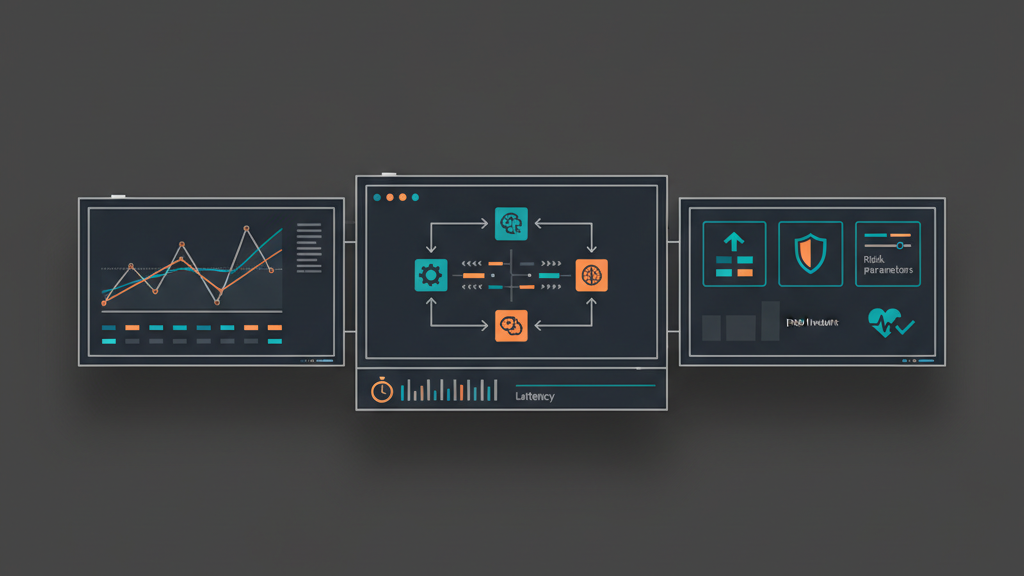
Risk management is non-negotiable when building robust live trading execution systems. A comprehensive framework includes both pre-trade and post-trade checks designed to prevent unintended exposure and limit potential losses. Pre-trade risk controls can include maximum order size limits, daily loss limits, and position exposure checks per instrument or strategy. Post-trade monitoring involves real-time tracking of profit and loss, capital usage, and portfolio-level risk metrics. Automated ‘circuit breakers’ or ‘kill switches’ are essential components, allowing for immediate cessation of trading activity under predefined adverse conditions or manual intervention. These controls act as critical safeguards, protecting capital and ensuring regulatory compliance. Implementing multiple layers of risk controls helps mitigate unforeseen market events or system malfunctions, which is vital for sustained operation in high-frequency trading.
- Implement pre-trade checks for order size, price deviation, and capital limits.
- Monitor real-time exposure and profit/loss across all active strategies.
- Develop automated circuit breakers to halt trading based on predefined loss thresholds.
- Provide a global ‘kill switch’ for immediate manual cessation of all trading activities.
- Ensure compliance with regulatory requirements for risk monitoring and reporting.
Monitoring, Logging, and Alerting for Operational Resilience
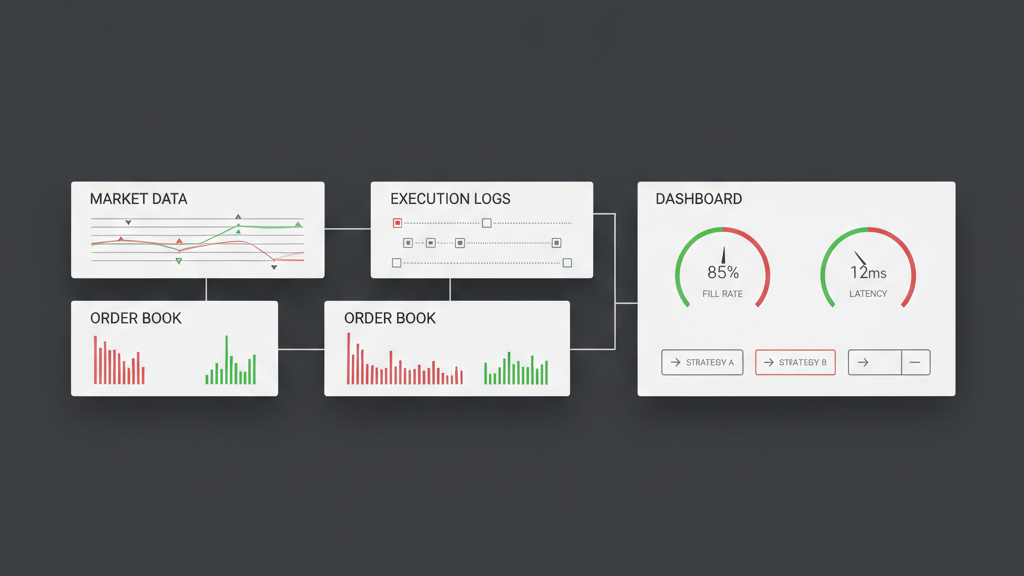
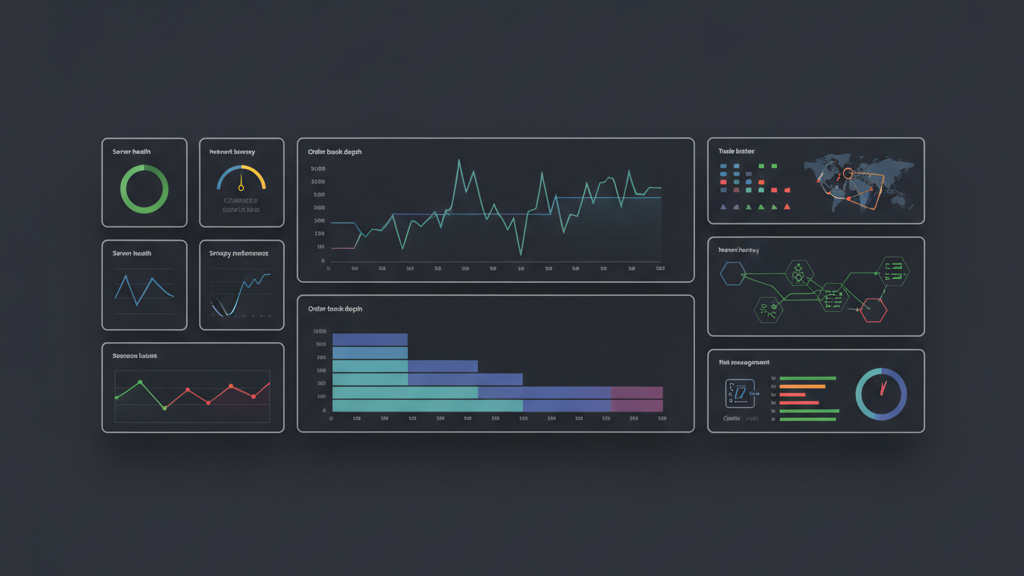
Effective monitoring, detailed logging, and proactive alerting are cornerstones of operational resilience for any HFT execution platform. A real-time dashboard should provide a holistic view of system health, network connectivity, market data integrity, and strategy performance. Granular logging of all trading events, system actions, and market interactions is crucial for debugging, post-mortem analysis, and regulatory audits. Alerting mechanisms must be configured to notify operators instantly of critical issues, such as connectivity loss, abnormal order flow, or significant performance deviations. The ability to quickly identify and diagnose problems minimizes downtime and prevents financial losses. This layer of operational intelligence is vital for maintaining uptime and ensuring the continuous, reliable operation of high-frequency trading strategies in a dynamic market environment.
- Deploy real-time dashboards for comprehensive system, market, and strategy monitoring.
- Implement granular logging for all trading events, system metrics, and error conditions.
- Configure proactive alerts for critical events, sending notifications via multiple channels.
- Regularly review logs for anomalies, performance bottlenecks, and potential security threats.
- Develop automated recovery procedures for common system failures based on alert triggers.
Rigorous Deployment, Testing, and Rollout Strategies
The deployment of HFT systems demands a rigorous and controlled process, minimizing the risk of introducing errors into the live environment. Extensive testing in simulated environments, including backtesting with historical data and paper trading with live feeds, is fundamental. Staging environments that mirror production infrastructure are crucial for pre-deployment validation. Implementing A/B testing or ‘dark launches,’ where a new version runs in parallel with the old but without actively trading, can provide confidence before full activation. A well-defined rollout strategy, possibly involving phased deployment or controlled ramp-ups, helps manage risk. Furthermore, robust emergency rollback procedures are essential, allowing for a swift return to a stable previous version if unforeseen issues arise post-deployment. This disciplined approach ensures stability and reliability when deploying new features or strategies into a live, high-stakes trading environment.
- Conduct comprehensive backtesting and paper trading in environments mimicking production.
- Utilize staging environments for pre-deployment validation and regression testing.
- Implement A/B testing or dark launches to validate new system components with live data.
- Plan phased rollouts to incrementally expose strategies to the market.
- Establish clear and tested emergency rollback procedures for quick recovery from issues.