Achieving ultra-low latency execution for competitive algo trading performance is critical for market participants seeking an edge. This pursuit involves meticulous optimization across hardware, network, and software components. Every millisecond saved can translate into improved fill rates and better prices, directly impacting profitability. Strategies like high-frequency trading, arbitrage, and market making rely heavily on minimal execution delays. Even strategies with longer holding periods benefit from reduced slippage and better entry/exit points. Understanding and implementing measures to minimize latency is fundamental to building a robust, high-performance algorithmic trading system.
The Imperative of Latency in Algo Trading
In the competitive landscape of modern financial markets, the speed at which a trade instruction travels from an algorithmic strategy to an exchange and back is a critical determinant of success. Achieving ultra-low latency execution for competitive algo trading performance is not merely an advantage; for many strategies, it is a fundamental requirement. High-frequency trading, arbitrage, and market making strategies, in particular, depend heavily on minimizing the time taken for order placement, cancellation, and modification. Even strategies with longer holding periods can benefit significantly from faster execution, as it reduces slippage and ensures trades are filled at intended prices. Delays, even measured in microseconds, can lead to missed opportunities, adverse price movements, or being “front-run” by faster participants. Understanding the profound impact of latency on profitability and strategic advantage is the first step towards building a robust, high-performance algo trading system.
- Gain first-mover advantage on market events.
- Minimize slippage and adverse price movements.
- Improve fill rates for time-sensitive orders.
- Enable profitable high-frequency and arbitrage strategies.
Co-location and Proximity Hosting
Physical proximity to exchange matching engines offers the most direct and impactful reduction in network latency. Co-location involves placing your trading servers directly within the exchange’s data center or an adjacent facility, often referred to as proximity hosting. This setup minimizes the physical distance data packets must travel, allowing for the fastest possible communication. By connecting directly to the exchange via cross-connects, you bypass public internet routes and standard network infrastructure, accessing raw market data feeds and sending orders with minimal delays. While a significant investment, co-location is considered a foundational element for serious participants aiming for the lowest possible execution times in competitive trading environments.
- Place servers within exchange data centers.
- Utilize direct cross-connects to matching engines.
- Bypass public internet and reduce network hops.
- Receive raw, unfiltered market data feeds directly.
Network Infrastructure Optimization
Beyond co-location, optimizing the internal network infrastructure within the trading environment is crucial for achieving ultra-low latency. This includes selecting specialized network hardware designed for speed and reliability, such as ultra-low latency switches with features like cut-through forwarding. Implementing high-speed fiber optic cabling throughout the data path, from market data ingress to order egress, further reduces transmission times. Network tuning also involves configuring protocols and operating system settings to minimize overhead, prioritizing critical trading traffic, and ensuring efficient multicast data processing. Continuous monitoring of network performance helps identify bottlenecks and allows for proactive adjustments, ensuring consistent, high-speed data flow.
- Deploy ultra-low latency network switches.
- Use direct fiber optic connections exclusively.
- Optimize network protocols for minimal overhead.
- Prioritize trading data traffic (Quality of Service).
- Implement efficient multicast data processing.
Software and Algorithm Design for Speed
The efficiency of the trading algorithm and its underlying software is paramount for achieving low-latency execution. Well-designed software minimizes processing delays, ensuring that market data is consumed, strategies are evaluated, and orders are generated with the utmost speed. This often involves writing performance-critical components in low-level languages like C++ or Rust, utilizing efficient data structures, and applying careful memory management techniques. Event-driven architectures, where the system reacts instantly to new market data or internal events, are common. Avoiding unnecessary data copying, reducing context switching, and optimizing critical loops are key programming practices that contribute significantly to overall system responsiveness.
- Implement core logic in low-level languages (C++, Rust).
- Employ efficient data structures and algorithms.
- Minimize memory allocations and garbage collection.
- Optimize for cache coherency and CPU utilization.
- Utilize lock-free programming for concurrency.
Operating System and Hardware Tuning
Optimizing the operating system and underlying hardware can yield significant latency reductions. This includes using specialized Linux distributions or kernel builds tuned for real-time performance, which minimize non-deterministic delays. Techniques like CPU affinity ensure critical trading processes run on dedicated CPU cores, avoiding interference from other tasks. Bypassing the kernel network stack, such as with technologies like OpenOnload or DPDK, can reduce the processing overhead for network packets. Furthermore, leveraging specialized hardware like FPGAs (Field-Programmable Gate Arrays) or GPUs for specific computationally intensive tasks, such as strategy evaluation or signal processing, can accelerate operations far beyond what general-purpose CPUs can achieve.
- Tune OS kernel for real-time performance.
- Assign CPU affinity for critical processes.
- Implement kernel bypass networking solutions.
- Utilize FPGAs or GPUs for hardware acceleration.
- Disable non-essential OS services and background tasks.
Market Data Feed Optimization
The speed and efficiency of market data ingestion directly impact the ability of an algo to react swiftly. Opting for raw, direct exchange feeds over consolidated data vendors provides the fastest, most granular view of the market, free from the aggregation and transmission delays inherent in third-party services. These feeds typically use binary protocols, which are far more efficient to parse than text-based formats. Developing highly optimized feed handlers that can process immense volumes of data with minimal latency is essential. This includes minimizing parsing overhead, efficient data storage, and intelligent filtering to ensure only necessary data reaches the trading strategy, reducing overall processing burden.
- Subscribe to raw, direct exchange data feeds.
- Utilize efficient binary data protocols.
- Develop high-performance feed handlers.
- Minimize data parsing and transformation overhead.
- Implement intelligent data filtering at the source.
Execution Management Systems (EMS) and Order Routing
An optimized Execution Management System (EMS) and intelligent order routing are critical components for maintaining low latency from strategy signal to market execution. Direct Market Access (DMA) routes orders straight to the exchange without intermediate brokers or systems, minimizing hops and processing delays. Custom-built order routers can make ultra-fast decisions on which exchange or venue offers the best liquidity or fastest fill, based on real-time market conditions. Optimizing the FIX (Financial Information eXchange) protocol implementation, or even bypassing it with proprietary binary protocols where possible, further reduces message serialization and deserialization overhead. The goal is to ensure that once a trading decision is made, the corresponding order reaches the market venue with the absolute minimum delay.
- Implement Direct Market Access (DMA) for order routing.
- Develop custom, high-speed order routing logic.
- Optimize FIX protocol messaging or use binary alternatives.
- Minimize hops between strategy and exchange.
- Reduce latency in order acknowledgment and fill processing.
Monitoring and Continuous Improvement
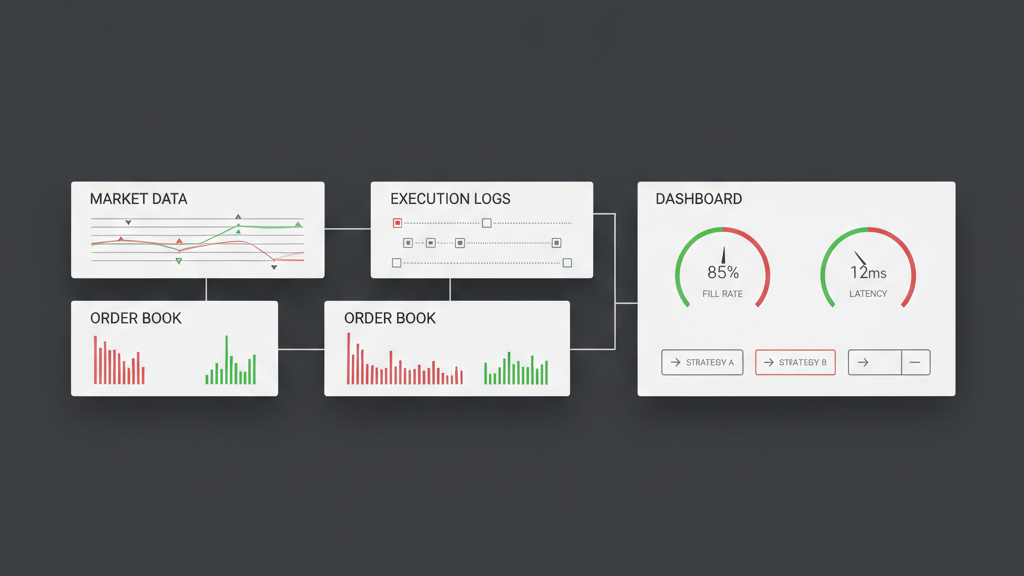
Achieving and maintaining ultra-low latency is an ongoing process that requires continuous monitoring and iterative refinement. Implementing comprehensive end-to-end latency measurement tools is vital to pinpoint bottlenecks across the entire trading pipeline, from market data arrival to order acknowledgment. Real-time dashboards displaying various latency metrics allow for immediate identification of performance degradation. Regular analysis of system logs and network packet captures can uncover hidden inefficiencies. Furthermore, A/B testing different hardware configurations, software optimizations, or network settings allows for empirical validation of improvements. This commitment to continuous improvement ensures that your algorithmic trading infrastructure remains competitive in the face of evolving market dynamics and technological advancements.
- Implement end-to-end latency monitoring.
- Analyze system logs and network traffic for bottlenecks.
- Benchmark and A/B test system changes.
- Regularly update hardware and software components.
- Perform proactive capacity planning and stress testing.