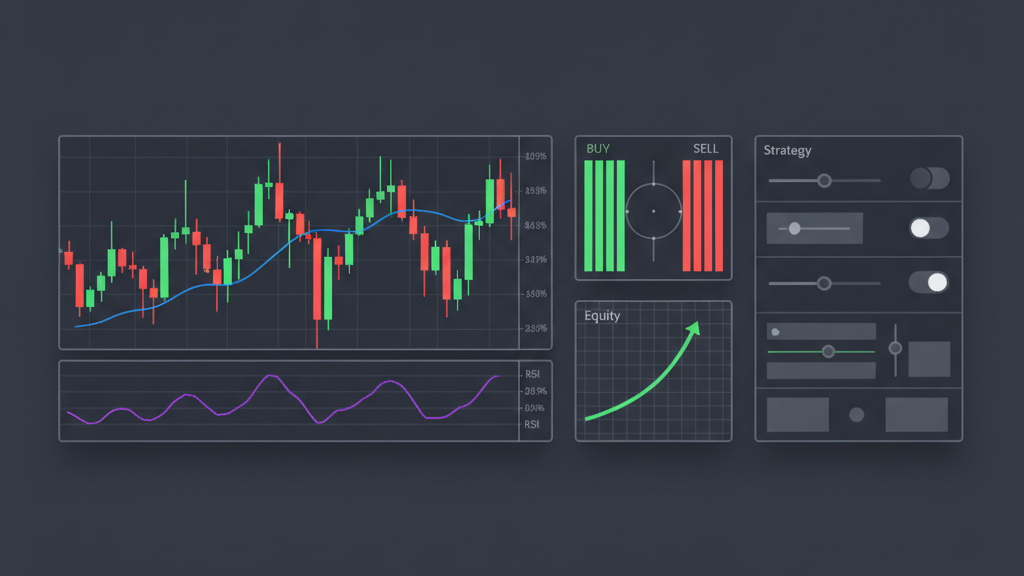
Developing profitable algo trading strategies begins with translating abstract concepts into concrete, measurable rules. This critical step, often termed quantification, allows for systematic testing and validation. The process of quantifying trading strategy ideas for backtesting with a custom trading script involves defining precise entry and exit conditions, incorporating robust risk management parameters, and preparing data for rigorous analysis. This approach ensures that a strategy’s potential is evaluated objectively, minimizing subjective bias and maximizing the chances of developing a reliable automated system. Successful quantification is the cornerstone of effective algorithmic trading, enabling traders to move from theoretical insights to practical, executable scripts.
The Necessity of Precise Strategy Quantification
Before any strategy can be automated or backtested, its underlying logic must be meticulously defined. Vague ideas like ‘buy when momentum is strong’ are insufficient for a machine to execute. Quantification involves transforming these qualitative notions into explicit, verifiable rules based on market data. This process forces clarity, identifies potential ambiguities, and ensures that the strategy’s behavior is predictable across different market conditions. A well-quantified strategy is reproducible and allows for objective performance measurement, which is fundamental for any credible backtesting effort. This foundational step minimizes errors and misunderstandings during the scripting phase, setting the stage for accurate and reliable testing.
- Define all strategy components with clear mathematical or logical rules.
- Translate subjective trading insights into objective, verifiable conditions.
- Ensure every decision point in the strategy is programmatically testable.
- Document the strategy logic meticulously to avoid future ambiguity.
- Identify and resolve any logical inconsistencies in the strategy rules.
Defining Measurable Entry and Exit Conditions
The core of any trading strategy lies in its entry and exit signals. Quantifying these signals means specifying exact price levels, indicator thresholds, timeframes, or combinations of factors that trigger trades. For example, instead of ‘buy when the stock looks cheap’, a quantified entry might be ‘buy when the 14-period RSI crosses below 30 and the price is above its 200-period moving average’. Similarly, exit conditions must be equally precise, whether they are stop-loss levels, take-profit targets, or time-based exits. These explicit rules are the instructions the custom trading script will follow, leaving no room for interpretation and enabling consistent execution during backtesting and live trading.
- Specify exact indicator values or price patterns for trade initiation.
- Establish clear stop-loss levels, either fixed or dynamic.
- Determine take-profit targets based on risk-reward ratios or technical levels.
- Incorporate time-based conditions, such as closing positions at market end.
- Use a combination of technical and fundamental criteria for robust signals.
Integrating Robust Risk Management and Position Sizing
An effective trading strategy extends beyond just entry and exit signals; it must incorporate comprehensive risk management and position sizing rules. These elements are crucial for capital preservation and sustainable growth. Quantifying risk means defining the maximum loss per trade, the daily or weekly drawdown limits, and how these limits trigger adjustments or temporary halts in trading. Position sizing rules dictate how many units of an asset to trade based on factors like account equity, volatility, or percentage risk per trade. Including these parameters directly within the strategy’s quantified rules ensures that risk is automatically managed, preventing catastrophic losses and promoting disciplined trading behavior across all market conditions, especially when executed by a custom script.
- Define maximum capital at risk per trade (e.g., 1-2% of account).
- Implement hard stop-loss orders as a primary risk control.
- Specify dynamic position sizing based on volatility or account equity.
- Set daily or weekly drawdown limits to protect capital.
- Quantify parameters for scaling in or out of positions.
Preparing Data for Scripted Backtesting
Accurate and reliable backtesting depends entirely on the quality and relevance of the data used. This preparation phase is crucial for quantifying trading strategy ideas accurately. Historical market data must be clean, free from errors, and representative of the market conditions the strategy is intended for. This includes ensuring correct timestamps, handling corporate actions like splits or dividends, and managing missing data points. Data fidelity directly impacts the validity of backtest results; poor data can lead to misleading performance metrics and flawed strategy conclusions. Therefore, a structured approach to data acquisition, cleaning, and storage is essential before feeding it into a custom trading script for backtesting.
- Acquire high-quality historical data, including tick, minute, or daily bars.
- Clean data by identifying and correcting errors, outliers, and gaps.
- Adjust for corporate actions such as stock splits and dividends.
- Synchronize data across multiple assets if the strategy involves pairs or portfolios.
- Store data efficiently in a format accessible by your backtesting environment.
Developing the Custom Trading Script
With quantified rules and prepared data, the next step is to translate the strategy into executable code. This involves writing a custom trading script using a programming language like Python, R, or a platform-specific language. The script must accurately encode all entry, exit, risk management, and position sizing rules. Modular design, where different components of the strategy are handled by separate functions, improves readability and maintainability. Thorough testing of individual script components before integrating them ensures functional correctness. This development phase brings the quantified strategy to life, enabling its systematic application to historical data for performance evaluation.
- Choose a suitable programming language or platform for script development.
- Implement each quantified rule as a distinct function or module.
- Ensure accurate calculation of indicators and price data transformations.
- Include robust error handling and logging mechanisms in the script.
- Design the script for efficient execution and data processing.
Interpreting Backtest Results and Iteration
Once the custom trading script runs against historical data, the output is a wealth of performance metrics. Interpreting these results goes beyond merely looking at net profit. Traders must analyze key statistics such as the equity curve, drawdown, profit factor, Sharpe ratio, win rate, and average trade size. These metrics provide a comprehensive view of the strategy’s profitability, risk characteristics, and consistency. Critical evaluation of these results often reveals areas for improvement. This iterative process involves refining the quantified strategy rules, adjusting parameters, or even revisiting core assumptions, and then re-running the backtest until satisfactory and robust performance is achieved without overfitting the data.
- Analyze the equity curve for smoothness, drawdowns, and recovery periods.
- Evaluate risk-adjusted returns using metrics like Sharpe or Sortino ratio.
- Assess trade statistics including win rate, average profit/loss, and maximum consecutive losses.
- Identify periods of underperformance and investigate their causes.
- Iteratively refine strategy parameters and rules based on backtest insights.
Beyond Backtesting: Stress Testing and Optimization
A successful backtest is a strong start, but it is not the final validation. Robust strategies must withstand various market conditions not necessarily present in the historical data used for initial backtesting. Stress testing involves exposing the strategy to extreme historical events, such as market crashes or periods of high volatility, to evaluate its resilience. Parameter optimization, on the other hand, systematically explores different combinations of input parameters to find the set that yields the best performance. However, care must be taken to avoid overfitting, which can lead to strategies that perform well on historical data but fail in live markets. These advanced validation steps are vital for confirming a strategy’s robustness before deployment.
- Subject the strategy to simulated extreme market conditions (stress testing).
- Perform walk-forward optimization to identify stable parameter sets.
- Conduct Monte Carlo simulations to assess strategy robustness across various scenarios.
- Evaluate sensitivity of results to minor changes in key parameters.
- Avoid excessive optimization that leads to overfitting historical data.