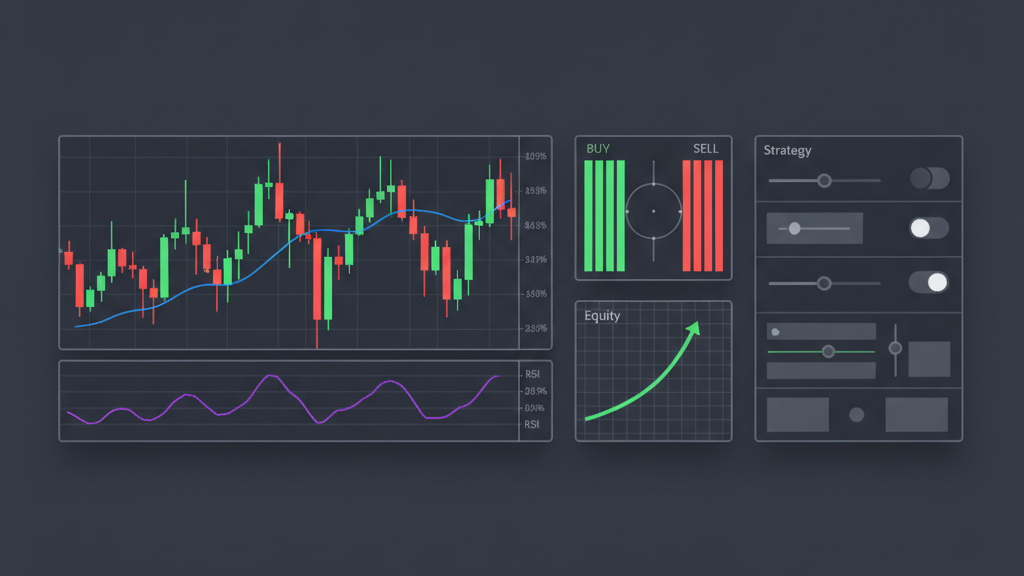
Developing a robust algorithmic trading strategy is only half the battle; the other half lies in proving its viability and resilience through rigorous backtesting. Efficient backtesting isn’t just about getting a result; it’s about rapidly iterating, validating hypotheses, and deeply understanding your strategy’s behavior across diverse market conditions without introducing bias. For anyone building automated trading systems, an efficient backtest engine is a non-negotiable component of the development pipeline. It’s the sandbox where ideas are tested, refined, and ultimately either validated for deployment or discarded. This process demands meticulous attention to data quality, realistic market modeling, and comprehensive performance evaluation to ensure that what works on paper genuinely stands a chance in the volatile live trading environment. Failing to backtest efficiently and accurately often leads to strategies underperforming or even failing catastrophically in production, making it a critical aspect of any serious algo development workflow.
The Foundation: Data Quality and Granularity for Realistic Simulation
The bedrock of any meaningful backtest is the quality and granularity of your historical data. As developers, we constantly face the ‘garbage in, garbage out’ dilemma, and in algo trading, this truth is amplified. To efficiently backtest, you need access to clean, reliable data that accurately reflects the market conditions your strategy will encounter. This means sourcing not just price and volume, but often also full order book depth, corporate actions, and dividend adjustments. Different strategies demand different data granularities; a high-frequency market-making algo requires tick-level data, while a daily momentum strategy might suffice with end-of-day bars. Common data challenges include survivorship bias in historical equity data, inconsistent timestamping across different feeds, missing data points due to exchange outages, or incorrect adjustments for splits and mergers. Building a robust data ingestion and cleaning pipeline is crucial; an efficient backtest isn’t just fast, it’s accurate because its inputs are sound. Neglecting these details will inevitably lead to misleading performance metrics and false confidence in your strategy.
Designing for Realism: Execution and Market Microstructure Modeling
A backtest is ultimately a simulation, and its predictive power hinges on how closely it mimics real-world execution. An efficient backtest engine must incorporate realistic models for market microstructure phenomena that significantly impact profitability. This includes accurately simulating slippage, which can occur due to market volatility, order size, or simply the bid-ask spread. For instance, a market order of 10,000 shares in a thinly traded stock won’t likely fill at the exact quoted price. Similarly, network and exchange latency play a crucial role, determining when your order actually reaches the market and when a fill confirmation is received. Modeling the order book depth is also critical for strategies that interact with liquidity, as it dictates the true cost of taking or providing liquidity. Ignoring these real-world frictions will invariably lead to an overoptimistic equity curve, making your strategy appear far more profitable than it would be in a live environment. Implementing configurable and dynamic models for these elements is essential for creating a backtesting environment that truly prepares a strategy for deployment.
- Implement variable slippage models, accounting for order size, current market liquidity, and asset type.
- Simulate network and exchange latency, introducing realistic delays in order placement and fill notifications.
- Model bid-ask spread and order book depth to determine actual fill prices for market and limit orders.
- Incorporate market impact for large trades, potentially adjusting future prices based on simulated volume and order flow.
Beyond P&L: Comprehensive Performance Evaluation Metrics
While profit and loss (P&L) are the ultimate measure of success, an efficient backtest demands a much deeper dive into performance metrics to truly understand a strategy’s strengths, weaknesses, and risk profile. Relying solely on raw P&L or total return can be highly misleading. Critical metrics for evaluating strategy robustness include the maximum drawdown, which quantifies the largest peak-to-trough decline in portfolio value, providing insight into potential capital at risk. Risk-adjusted returns, such as the Sharpe Ratio and Sortino Ratio, are indispensable for comparing strategies by normalizing returns against volatility or downside deviation. We also meticulously track the profit factor, win rate, average win/loss, and time in market, which offer granular views into trade-level performance and strategy efficiency. Additionally, a detailed breakdown of transaction costs – commissions, exchange fees, and implicit costs like slippage – is vital. These comprehensive metrics help identify strategies that not only generate returns but do so in a stable and repeatable manner, aligning with defined risk tolerances and capital preservation goals.
Mitigating Overfitting: Walk-Forward Optimization and Robustness Checks
One of the most insidious threats to an algorithmic trading strategy’s viability is overfitting. This occurs when a strategy’s parameters are excessively tuned to historical data, performing exceptionally well on past market conditions but failing catastrophically on unseen future data. To efficiently backtest and mitigate this risk, walk-forward optimization is a crucial technique. Instead of optimizing parameters once over the entire dataset, walk-forward analysis segments the historical data into sequential ‘in-sample’ (optimization) periods and ‘out-of-sample’ (testing) periods. Parameters are optimized on the in-sample data and then tested on the subsequent out-of-sample segment, simulating how a strategy would perform if it were regularly re-optimized and deployed. This process provides a more realistic assessment of a strategy’s adaptive performance. Complementing this, robustness checks involve perturbing optimized parameters slightly to see if performance degrades gracefully or collapses, identifying strategies that are too sensitive to minor parameter changes. These methods are fundamental for ensuring a strategy’s resilience across varying market regimes.
- Implement walk-forward optimization to train on historical data and test on unseen data sequentially, simulating real-world re-optimization cycles.
- Perform parameter sensitivity analysis by systematically testing strategy performance across a range of values around optimal settings.
- Utilize Monte Carlo simulations to evaluate strategy robustness under various market scenarios, including permutations of historical price paths.
- Conduct ‘stress tests’ by simulating extreme market conditions or black swan events not necessarily present in the primary backtest data.
Scaling Backtesting: Infrastructure and Parallelization for Comprehensive Analysis
As the number of strategies grows, or when performing extensive parameter optimizations and walk-forward analysis, the computational demands of backtesting can quickly become overwhelming. Efficient backtesting at scale requires a robust infrastructure capable of parallelizing numerous simulations. This often involves distributing backtest jobs across multiple cores, machines, or even cloud-based clusters. Key challenges include managing historical data synchronization across distributed nodes, ensuring consistent state for event-driven simulations, and efficiently aggregating vast amounts of results for analysis. Systems need to handle scenarios where a single strategy might be backtested thousands of times with different parameters or across multiple assets simultaneously. Leveraging frameworks designed for parallel processing, robust queueing systems, and distributed storage solutions becomes imperative. This not only dramatically reduces the time required for comprehensive testing but also allows quants to explore a much wider parameter space and test more complex hypotheses, ultimately leading to more thoroughly validated and robust strategies ready for live deployment. Algovantis, for example, prioritizes scalable solutions to tackle these very problems, enabling rapid iteration cycles.