In algorithmic trading, a well-defined strategy is only half the battle; the other, equally critical half is robust risk management. While MetaTrader 4 (MT4) offers basic stop-loss and take-profit functionality, real-world trading demands far more sophisticated controls, especially when dealing with multiple instruments, volatile markets, or high-frequency execution. This article delves into implementing advanced risk management techniques in MT4 using MQL4 scripts, moving beyond static parameters to dynamic, adaptive controls that can protect capital and preserve strategy longevity. We’ll explore practical approaches to integrating these controls directly into your Expert Advisors (EAs) and custom scripts, addressing common challenges and highlighting best practices for maintaining system integrity.
The Imperative of Dynamic Risk Controls in MQL4
Relying solely on fixed stop-losses often proves insufficient in dynamic market conditions or during periods of high volatility. A static stop might be too tight for one market regime, leading to premature exits, or too wide for another, exposing the account to excessive risk. Effective implementation of advanced risk management techniques in MT4 using MQL4 scripts addresses this by allowing for adaptive responses. This means dynamically adjusting parameters like stop-loss levels, position sizes, and exposure limits based on real-time market data, account equity, or even internal strategy performance metrics. The goal is to move from a reactive, fixed-rule approach to a proactive, adaptive system that can better withstand market shocks and prolong the life cycle of a trading strategy, mitigating the impact of unforeseen events or market microstructure anomalies that fixed stops simply cannot account for.
Dynamic Position Sizing Based on Volatility and Account Health
One of the foundational advanced risk management techniques is dynamic position sizing, which ensures your exposure per trade is proportional to your available capital and the market’s current volatility. Instead of using a fixed lot size, MQL4 scripts can calculate the optimal trade volume by factoring in the account’s current free margin (using `AccountInfoDouble(ACCOUNT_FREEMARGIN)`), the instrument’s point value, and a calculated risk per trade percentage. Incorporating volatility, perhaps via an Average True Range (ATR) indicator, allows the script to size positions smaller during volatile periods (where stop-losses might be wider) and larger during calmer times. This ensures that the potential monetary loss from hitting a stop-loss remains relatively consistent, regardless of market conditions, thereby standardizing risk units across diverse trading environments and instrument types. MQL4 provides robust functions like `MarketInfo()` or `SymbolInfoDouble()` to fetch necessary instrument data for these calculations.
- Use `AccountInfoDouble(ACCOUNT_FREEMARGIN)` to determine available capital.
- Calculate risk per trade as a percentage of equity, e.g., 1-2%.
- Integrate ATR or other volatility metrics to adjust stop-loss distance and corresponding lot size.
- Validate calculations across different instruments with varying point values and contract sizes.
Implementing Granular Trailing Stops and Breakeven Logic
Beyond simple trailing stops, advanced risk management in MT4 can incorporate granular, multi-stage trailing and sophisticated breakeven logic. A basic trailing stop might move the stop-loss a fixed number of pips behind the price. A more advanced approach involves incremental adjustments as the trade progresses, potentially moving the stop faster or in larger steps once a certain profit threshold is reached, or even implementing partial profit-taking at pre-defined levels. Breakeven logic can also be refined to account for spread and commission, ensuring the stop-loss is truly at a zero-profit/zero-loss point, not just the entry price. MQL4’s `OnTick()` and `OnTrade()` event handlers are critical for real-time monitoring and modification of pending orders or open positions, though developers must be mindful of execution latency and potential slippage, especially when rapid modifications are required. Poorly implemented trailing can lead to whipsaws or missed profit opportunities due to slow updates.
System-Wide Exposure and Drawdown Control
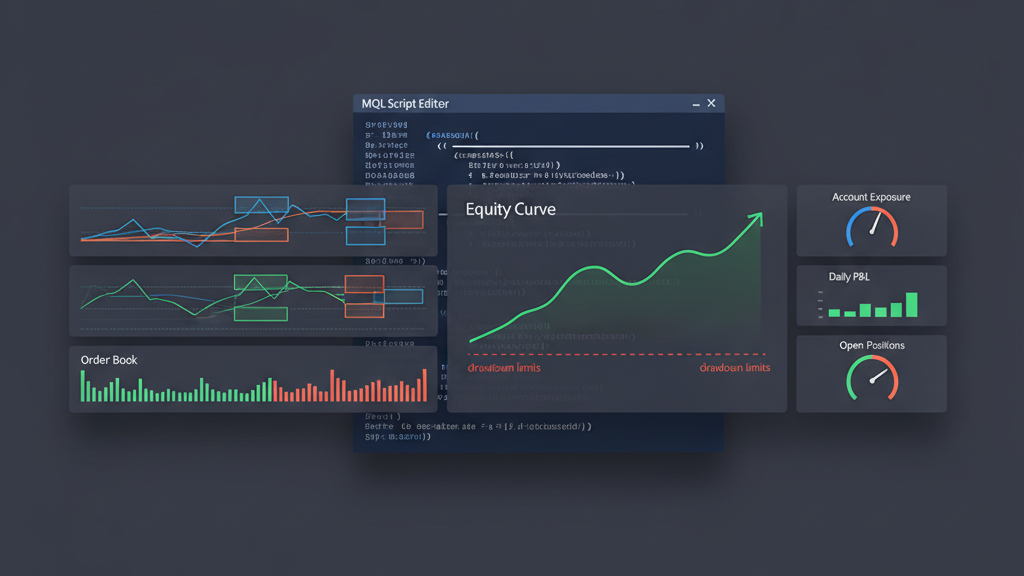
Effective advanced risk management extends beyond individual trades to the entire trading system or portfolio. MQL4 can be scripted to monitor and enforce limits on total open positions, maximum exposure across various symbols, or cumulative daily/weekly drawdown. This is particularly crucial when running multiple Expert Advisors concurrently or managing a basket of strategies. Implementing system-wide controls often requires shared data mechanisms, such as global variables, shared files, or custom indicators that aggregate risk metrics from all active EAs. For example, an MQL4 script can check the total floating P&L against a predefined daily drawdown limit, and if exceeded, temporarily disable all trading and even close existing positions. The challenge lies in ensuring all components report correctly and respond coherently, avoiding race conditions or stale data when multiple EAs attempt to update shared risk parameters simultaneously.
- Define maximum open positions or total lot size across all active instruments.
- Implement daily, weekly, or monthly drawdown limits based on account equity.
- Develop a centralized MQL4 ‘risk monitor’ EA to aggregate data from other EAs.
- Utilize `GlobalVariableSet()`/`GlobalVariableGet()` for inter-EA communication of risk states.
Implementing Circuit Breakers and Emergency Stop Functionality
Even with sophisticated controls, extreme market events or unexpected system behavior can occur. Therefore, an essential aspect of implementing advanced risk management techniques in MT4 using MQL4 scripts is the creation of robust circuit breakers or ‘panic buttons.’ These are automated safeguards designed to halt all trading activity and potentially close all open positions under predefined emergency conditions. Triggers could include an exceptionally large single-trade loss, a rapid and severe account drawdown, or even a pre-configured manual override. The MQL4 script for this functionality needs to be highly optimized for speed and resilience, ensuring it can execute market orders quickly (`OrderClose()` with `OP_SELL`/`OP_BUY` and `OrderSelect()` for iteration) even under duress. Clear state management (e.g., persistent flags stored in `GlobalVariableSet()` or file operations) is vital to prevent the system from re-entering trades inadvertently after an emergency stop, ensuring full control is regained before resuming operations.
Backtesting and Validating Your Advanced Risk Management Logic
Implementing advanced risk management techniques in MT4 using MQL4 scripts isn’t complete without rigorous backtesting and validation. It’s not enough to test the strategy’s entry and exit points; the risk management logic itself must be put under extreme scrutiny. This involves simulating various adverse market conditions, including periods of high volatility, significant price gaps, and even simulating slippage greater than typical. Custom backtesting environments or specialized MQL4 scripts can be developed to intentionally stress-test the risk controls, ensuring they behave as expected when faced with large drawdowns, unexpected API failures (simulated order rejections), or rapid price movements. Validating the interaction between the core strategy and the risk overlay is crucial, as an overly aggressive risk manager might choke a profitable strategy, while a too lenient one might expose the capital unnecessarily. Thorough evaluation of the equity curve, maximum drawdown, and recovery factor under these stress tests provides critical insight into the resilience of your risk framework.
- Simulate adverse market events like large gaps, rapid volatility shifts, and unexpected slippage.
- Verify the risk controls prevent drawdown breaches during simulated stress scenarios.
- Test edge cases: what happens if an order fails to close due to a broker error?
- Analyze equity curves for stability and robustness, not just overall profit, after applying risk controls.