

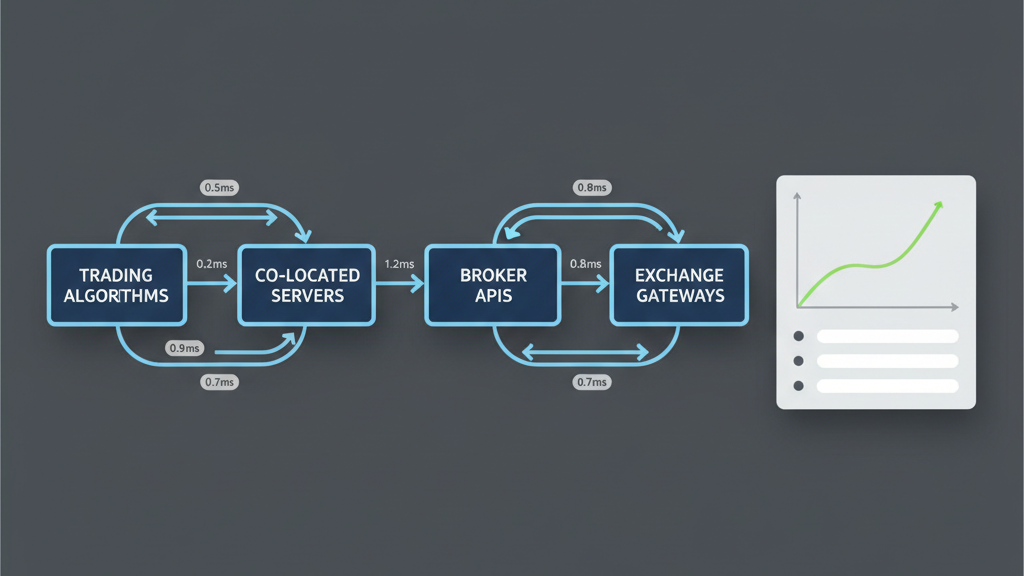
Developing an effective algorithmic trading system requires more than just a profitable strategy; it demands robust and performant execution infrastructure. At the core of this infrastructure lies the broker API integration, particularly when low latency order routing is a non-negotiable requirement. The way a system connects, communicates, and manages orders with a brokerage API directly impacts execution quality, slippage, and ultimately, profitability. This isn’t just about sending an order; it’s about minimizing every microsecond in the round trip, managing market state, and building resilience against real-world network and API constraints. We need to look beyond simple API calls and consider the full spectrum of architectural choices, data handling, and error recovery mechanisms that contribute to a truly optimized low latency setup.
Understanding Low Latency Order Routing Fundamentals
Achieving genuinely low latency order routing isn’t just about having a fast internet connection; it’s a systemic concern spanning network topology, API design, and application logic. Latency is the sum of many small delays: network propagation, broker gateway processing, exchange matching engine queueing, and the time taken for acknowledgments to return. For high-frequency strategies, even a few milliseconds can significantly impact fill rates and price certainty, turning a profitable edge into slippage. When integrating with a broker API, our focus must be on minimizing the time spent in each of these stages, often requiring co-location services, dedicated network lines, and careful selection of API communication protocols. Understanding the critical path of an order from strategy signal to exchange execution and back is fundamental to identifying and optimizing bottlenecks. It’s a continuous optimization problem, not a one-time setup.
Common Broker API Integration Architectures
The choice of architecture for broker API integration is often dictated by the target latency requirements and the broker’s offerings. Direct REST APIs are generally simpler to implement but introduce HTTP overhead and connection setup delays, making them less suitable for extreme low latency order routing. WebSockets offer persistent connections, reducing handshake latency, and are often preferred for real-time data streaming and order updates. For the absolute lowest latency, many institutional brokers provide FIX (Financial Information eXchange) protocol gateways. FIX is an industry standard designed for high-speed, reliable message exchange, often requiring specialized libraries and a deeper understanding of session management. Implementing a FIX client means managing sequence numbers, heartbeats, and resend requests, adding complexity but delivering superior performance. The decision usually comes down to a trade-off between implementation effort, required infrastructure, and the specific latency tolerance of the trading strategy.
- Direct REST API: Simpler, higher latency, suitable for slower strategies.
- WebSocket API: Persistent connection, lower latency, good for real-time data and order updates.
- FIX Protocol Gateway: Industry standard, lowest latency, higher implementation complexity, requires robust session management.
Optimizing Order Submission Pathways
To minimize the critical path for order submission, several techniques can be employed beyond just the communication protocol. One significant factor is the physical proximity to the broker’s execution gateway; co-location services reduce network latency to near-zero, often measured in microseconds. Within the application, optimizing message serialization and deserialization is crucial. Using highly efficient binary protocols or carefully designed JSON structures can reduce processing time. Furthermore, intelligent order batching, where multiple orders are consolidated and sent in a single request, can improve throughput but might introduce latency for individual orders. For extremely low latency, systems are often designed to bypass middleware layers, directly interacting with kernel-level network stacks. It’s also vital to minimize any synchronous operations in the order path, pushing non-critical tasks to asynchronous queues. Every line of code, every network hop, and every data transformation must be scrutinized for latency impact.
Resilience: Handling API Rate Limits and Failovers
Real-world broker API integration is not always a smooth highway; it’s often a bumpy road with rate limits, temporary service degradations, and unexpected disconnections. Designing for resilience is paramount. Implementing robust rate limiters on the client side is essential to avoid triggering API blocks, using algorithms like token buckets or leaky buckets to control request frequency. Furthermore, a well-architected system includes failover mechanisms. This could involve multiple connections to the same broker, routing orders through redundant API endpoints, or even switching to an entirely different broker API if the primary one becomes unresponsive. Circuit breaker patterns are invaluable here, automatically preventing further requests to a failing service and allowing it to recover. A critical aspect is maintaining consistent state: during a failover or reconnection, the system must accurately reconcile its internal view of open orders and positions with the broker’s. This often requires fetching all open orders upon reconnection and performing a careful delta comparison, accounting for potential race conditions during the transition.
- Client-side Rate Limiting: Implement token bucket or leaky bucket algorithms to avoid API blocks.
- Failover Mechanisms: Route orders through redundant endpoints or switch to backup brokers.
- Circuit Breaker Pattern: Automatically prevent requests to failing services, allowing recovery.
- State Reconciliation: Fetch open orders and positions upon reconnection to ensure data consistency.
Data Integrity and System State Management
Maintaining accurate data integrity and a consistent system state between the trading engine and the broker is one of the most challenging aspects of broker API integration. Misaligned states can lead to phantom orders, incorrect position sizing, or missed fills, causing significant financial risk. The system must reliably process order acknowledgments, fills, and cancellations, even when messages arrive out of order or are duplicated by the broker. Employing idempotent operations for order submission is crucial, preventing duplicate order placement if a request is retried. Furthermore, periodic reconciliation processes, perhaps daily or intra-day, compare the trading system’s known positions and open orders against the broker’s actual records. Any discrepancies trigger alerts and manual review. This involves not just processing live updates but also designing robust recovery logic for cold starts or unexpected shutdowns, ensuring the system can accurately rebuild its state based on a reliable source of truth from the broker’s API.
Monitoring and Performance Evaluation
Once a low latency order routing system is deployed, continuous monitoring and performance evaluation become critical for maintaining its edge. This involves tracking key metrics such as order-to-fill latency, acknowledgment times, and the rate of API errors or rejections. Granular timestamps should be logged at various stages: when an order is generated by the strategy, when it’s sent to the broker API, when the acknowledgment is received, and when the fill notification arrives. These metrics help identify bottlenecks, whether they’re in the local network, the broker’s processing, or the exchange itself. Visualization tools for these latency profiles can quickly highlight deviations from expected performance. Beyond latency, monitoring system health, CPU usage, memory consumption, and network I/O helps ensure the underlying infrastructure isn’t introducing unexpected delays. A proactive monitoring setup, with alert thresholds, allows for immediate action on performance degradation, which is vital in a high-stakes low latency environment.