Developing robust mean reversion trading systems often hinges on precise entry and exit signals. The Relative Strength Index (RSI) is a ubiquitous tool for identifying overbought and oversold conditions, signaling potential price reversals. However, simply applying standard RSI 70/30 thresholds for mean reversion bots rarely yields optimal results in live trading. The true challenge lies in understanding how to effectively determine, validate, and dynamically adjust these indicator thresholds to suit varying market regimes, instrument characteristics, and trading objectives. This article explores practical considerations, from initial backtesting to live execution, focusing on methodologies that go beyond static rules to build more resilient and profitable mean reversion strategies.
The Foundational Role of RSI in Mean Reversion
The Relative Strength Index measures the speed and change of price movements, oscillating between 0 and 100. For mean reversion strategies, extreme RSI values – typically above 70 for overbought and below 30 for oversold – are interpreted as signals that an asset’s price has deviated significantly from its recent average and is likely to revert. The core premise is that markets tend to return to their mean over time, and RSI helps quantify when a deviation is substantial enough to warrant a reversal trade. However, relying on fixed, universally applied RSI overbought oversold indicator thresholds for mean reversion bots often overlooks critical market dynamics. What constitutes ‘extreme’ can vary wildly between a highly volatile tech stock and a stable utility, or across different timeframes and market conditions. A common pitfall is assuming these standard thresholds will work equally well across all assets and market states without proper validation.
Static vs. Dynamic Thresholds: An Operational Dilemma
The choice between static and dynamic RSI thresholds is a critical design decision for mean reversion bots. Static thresholds, like the conventional 70/30, are simple to implement but brittle. They fail to adapt to changes in volatility, market regime shifts (e.g., trending vs. ranging), or an asset’s inherent characteristics. A stock that consistently trades within a narrow band might trigger overbought at 60 RSI, while another, prone to large swings, might not be truly overbought until 85. Dynamic thresholds, in contrast, adjust based on recent market data. This could involve using a rolling percentile of historical RSI values, incorporating volatility metrics, or adapting to the average true range. While more complex to develop and maintain, dynamic thresholds offer superior robustness, reducing false signals and improving trade timing, especially in markets that are not always perfectly mean-reverting.
- Static thresholds (e.g., 70/30) are prone to whipsaws and missed opportunities in varying market conditions.
- Dynamic thresholds can be derived from rolling historical RSI percentiles or volatility-adjusted ranges.
- Implementing dynamic thresholds requires continuous data analysis and often more complex scripting within the trading platform.
- A common approach involves adjusting thresholds based on the market’s standard deviation of RSI over a lookback period.
Backtesting and Optimization for Robust Thresholds
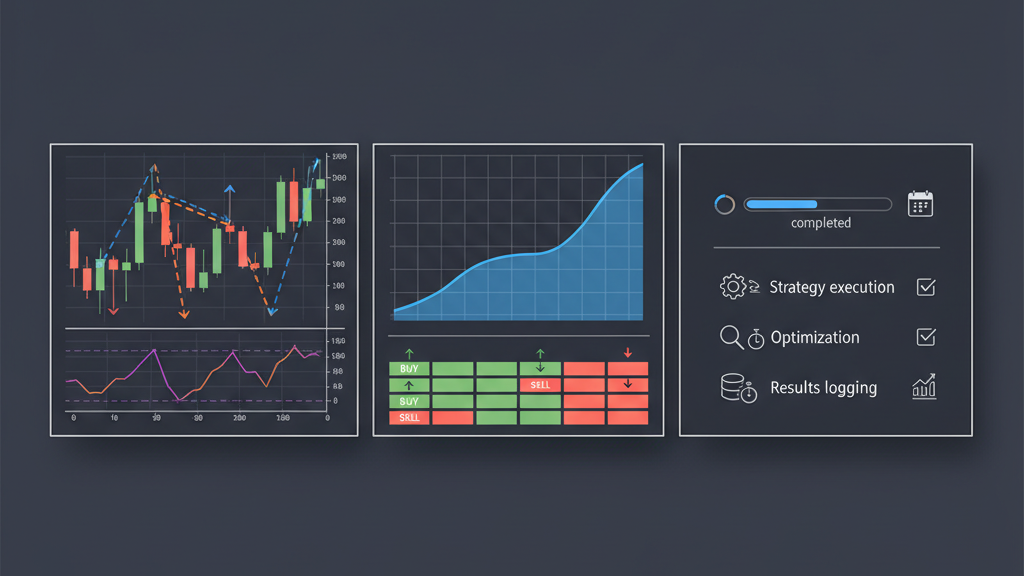
Effective backtesting is non-negotiable when determining optimal RSI overbought oversold indicator thresholds for mean reversion bots. Instead of a simple parameter sweep, advanced strategies include walk-forward optimization, where thresholds are optimized over a training period and then tested on a subsequent out-of-sample period, repeating this process. This method helps gauge the stability of the chosen thresholds and identifies parameters that are less prone to overfitting. Robustness checks should also involve varying the lookback period of the RSI itself, as this significantly impacts the indicator’s sensitivity. Furthermore, backtesting must account for realistic trading costs like slippage and commissions; a seemingly profitable set of thresholds can quickly turn unprofitable once these real-world factors are introduced. Thorough data validation, including checking for survivorship bias and look-ahead bias in historical data, is paramount to ensure the backtest results are reliable.
Execution Challenges and Threshold Interaction
The chosen RSI thresholds don’t operate in a vacuum; they dictate entry and exit points, directly influencing execution quality. Tighter overbought/oversold levels, while potentially offering early entries, can increase the frequency of trades, leading to higher transaction costs and greater exposure to adverse market microstructure effects like latency and slippage. For instance, a mean reversion bot triggering at an RSI of 80 might find fewer immediate liquidity providers than one triggering at 75, especially in fast-moving markets, leading to worse fills. It’s crucial to model expected slippage based on historical spread and volume data during backtesting. Furthermore, API rate limits and network latency can delay order placement, causing the market to move past the optimal entry point defined by the threshold. Implementing robust retry logic and intelligent order routing mechanisms is essential to mitigate these execution gaps and ensure the bot can act decisively on its signals.
- High-frequency mean reversion strategies with tight thresholds are highly sensitive to market microstructure effects.
- Slippage can erode profitability significantly, especially for small-edge trades triggered by precise RSI levels.
- Latency in order placement, due to network delays or API limitations, can render an ‘optimal’ threshold irrelevant.
- Consider using limit orders near the threshold trigger, but be aware of the risk of non-execution.
- Impact of market impact: large orders placed based on RSI signals can move the market against the bot.
Integrating Risk Management with Threshold Logic
Even the most optimized RSI thresholds for mean reversion bots can fail in sustained trends or black swan events. Therefore, robust risk management must be interwoven with the threshold logic. This means not just setting fixed stop-losses, but also potentially dynamically adjusting them or implementing time-based exits if the mean reversion doesn’t occur within an expected timeframe. For instance, if a position based on an RSI overbought signal continues to trend higher, a pre-defined maximum adverse excursion (MAE) or a reversal of a longer-term trend indicator might trigger an immediate exit, overriding the standard RSI exit condition. Furthermore, position sizing should ideally be dynamic, perhaps scaling down exposure during periods of high volatility or when the RSI signal is near a less ‘extreme’ threshold, offering less conviction. The goal is to minimize drawdowns when the core assumption of mean reversion temporarily breaks down, which it inevitably will.
Data Quality and RSI Lookback Period Sensitivity
The accuracy and responsiveness of RSI overbought oversold indicator thresholds for mean reversion bots are profoundly affected by the underlying data quality and the chosen lookback period. Low-quality data – with missing ticks, incorrect quotes, or unreliable timestamps – can produce erroneous RSI values, leading to false signals and poor trade decisions. Pre-processing steps like data cleaning, outlier detection, and interpolation are crucial. The RSI lookback period (e.g., 14 periods) dictates how far back the indicator considers price data. A shorter lookback makes RSI more volatile and prone to whipsaws, generating more signals but potentially less reliable ones. A longer lookback smooths out the indicator, reducing false signals but potentially delaying entries or exits, which can be detrimental in fast-moving mean reversion scenarios. Experimenting with different lookback periods and validating their impact on strategy performance during backtesting is vital to find a balance between responsiveness and signal stability.
- Garbage in, garbage out: dirty data can drastically skew RSI calculations and lead to erroneous signals.
- Verify data feeds for consistency, completeness, and accuracy before using them for indicator calculations.
- A shorter RSI lookback period increases sensitivity, leading to more signals but also more noise.
- A longer RSI lookback period smooths the indicator, reducing noise but potentially introducing lag.
- Perform sensitivity analysis on the RSI lookback period during optimization to understand its impact on strategy robustness.