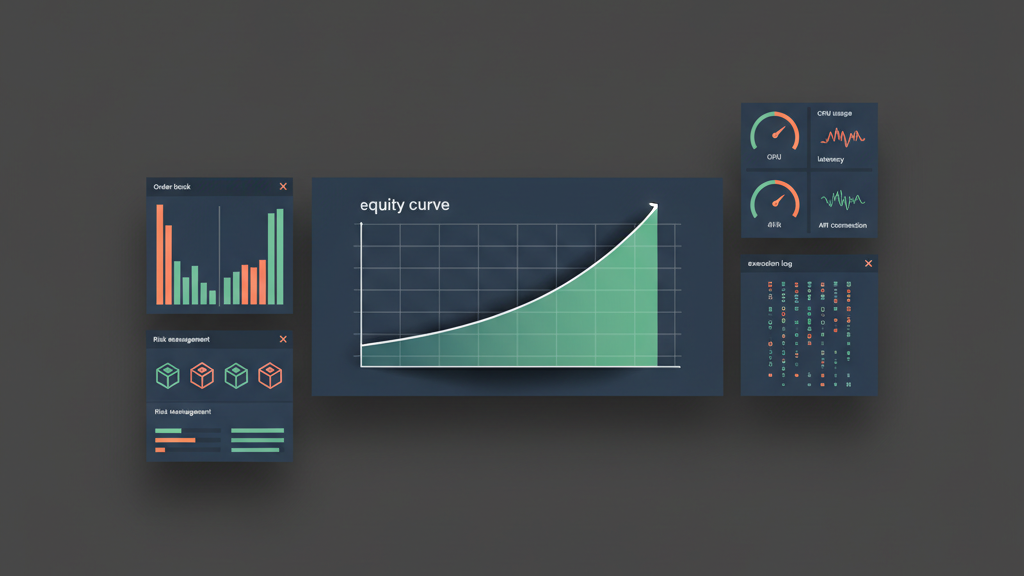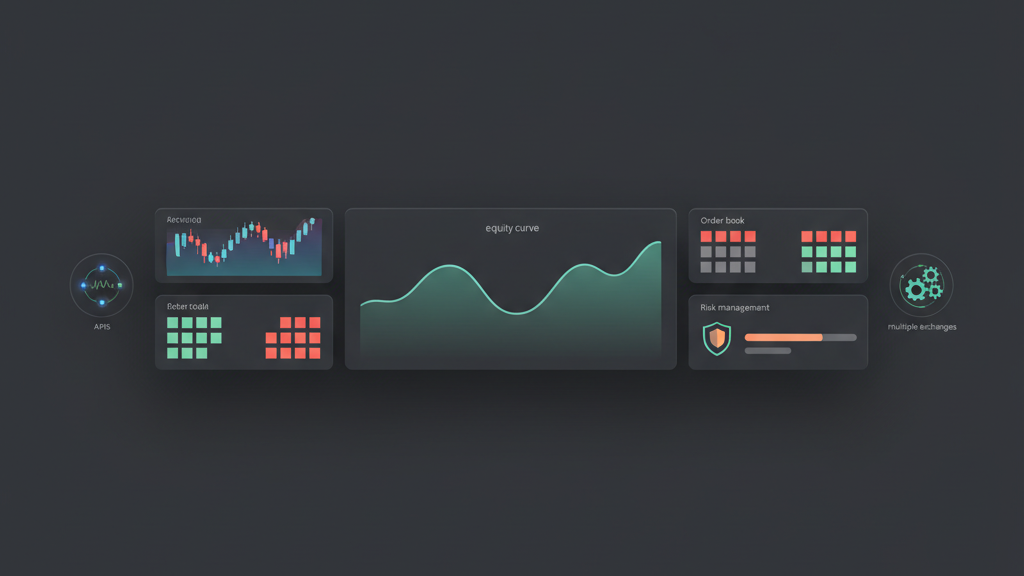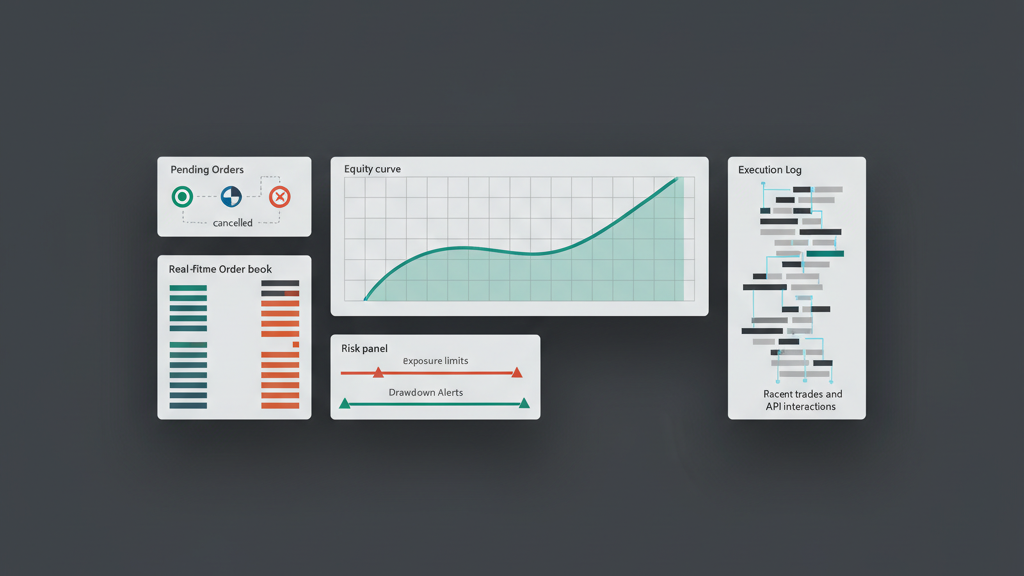
Developing an algorithmic trading system extends far beyond just strategy formulation. The true backbone of any production-grade system lies in its ability to manage orders reliably and control execution risks. This isn’t a theoretical exercise; it’s about engineering a resilient framework that can handle market volatility, API quirks, and unforeseen edge cases without catastrophic failures. Robust trading system order management and execution risk controls are non-negotiable components, demanding meticulous design and rigorous testing. From ensuring atomic order state transitions to implementing circuit breakers that prevent runaway algorithms, every detail matters when capital is on the line. This article will explore the practical considerations and architectural decisions involved in building such a system, drawing from real-world challenges faced by quantitative teams and platform developers.
The Core Components of an Order Management System (OMS)
At the heart of any trading system is its Order Management System, a critical component responsible for the entire lifecycle of an order. This includes receiving order requests from strategies, routing them to brokers or exchanges, tracking their status, and handling acknowledgments and fills. A robust OMS must be stateful, maintaining an accurate and persistent record of every order’s journey from submission to final settlement. Key implementation challenges often revolve around ensuring idempotency for resubmissions, handling network partitions gracefully, and managing concurrent updates to order states across multiple threads or services. Developers must design for eventual consistency, especially when dealing with distributed components, ensuring that the system’s internal state accurately reflects the external reality reported by the exchange, even in the face of partial fills or unexpected cancellations.
- Order state machine design (New -> AwaitingAck -> PendingNew -> Filled/PartialFill/Rejected/Canceled)
- Persistent storage for order history and current open orders (e.g., PostgreSQL, Redis for speed)
- Asynchronous communication with exchange APIs to prevent blocking I/O
- Logic for handling duplicate order IDs and re-attempting failed submissions
Implementing Pre-Trade Risk Checks
Before any order even leaves the trading system, a series of stringent pre-trade risk checks must be applied. These controls are the first line of defense against erroneous or overly aggressive trading behavior, acting as a gatekeeper to protect capital. Common checks include position limits, ensuring that the proposed order won’t exceed a predefined maximum exposure for a specific instrument or sector, and capital limits, which verify sufficient available funds before a buy order is placed. Price collars are also crucial, preventing orders from being submitted at prices significantly divergent from the current market, thereby protecting against ‘fat finger’ errors or logic bugs that generate extreme price points. Implementing these checks requires access to real-time portfolio data and market data feeds, ensuring that the validation logic operates on the most current information available, often with very strict latency requirements to avoid stale data impacting decisions.
Real-time Execution Risk Controls and Monitoring
Beyond pre-trade validation, effective trading system order management and execution risk controls demand continuous real-time monitoring. This involves tracking key metrics like current P&L, drawdown, and daily maximum loss thresholds against defined limits. If any metric breaches a critical threshold, automated responses, such as pausing new order generation or initiating a full position liquidation, must be triggered instantly. Implementing circuit breakers that halt trading for specific symbols or the entire system under extreme volatility, or if a certain number of API errors occur within a short period, is also vital. These controls mitigate the impact of market dislocations, connectivity issues, or unforeseen algorithmic behavior, often requiring highly optimized data pipelines to process streaming trade data and calculate risk metrics with minimal latency, sometimes leveraging in-memory databases or stream processing frameworks for rapid analysis and decision-making.
- Automated P&L and drawdown monitoring with hard-stop limits
- Volume and velocity checks to detect runaway algorithms
- Real-time slippage monitoring and adaptive order sizing
- Connectivity health checks and automatic failover/kill-switch activation
Addressing Latency and Slippage in Execution
Latency and slippage are inherent challenges in algorithmic trading that directly impact profitability and execution quality, requiring meticulous attention within the trading system’s design. Latency, the delay between a decision and its execution, can be introduced by network hops, API processing times, or internal system bottlenecks. Minimizing this means optimizing hardware, co-locating servers, and employing efficient data structures and algorithms. Slippage, the difference between the expected and actual execution price, is a direct consequence of market impact, liquidity, and latency. Effective execution risk controls involve not just monitoring slippage, but also actively managing it through intelligent order types, such as limit orders with adaptive price setting, or using VWAP/TWAP algorithms that spread orders over time. A common mistake is to assume market data is perfectly synchronized with execution, leading to stale price references, which can exacerbate slippage. Continuous calibration against historical execution data and real-time market conditions is essential to keep these risks in check.
Designing Failsafe Mechanisms and Emergency Procedures
Despite robust pre-trade checks and real-time monitoring, a comprehensive trading system must incorporate failsafe mechanisms and clearly defined emergency procedures. These are the ‘break glass in case of emergency’ features designed to prevent catastrophic losses when all other controls fail or an unexpected event occurs. Critical failsafes include ‘panic buttons’ or ‘kill switches’ that immediately cancel all open orders and flatten positions across selected instruments or the entire portfolio. This functionality must be accessible, responsive, and robust, often implemented as a dedicated, high-priority service that bypasses standard order pathways. Beyond automated systems, clear operational procedures for manual intervention, communication protocols for critical incidents, and well-rehearsed recovery plans are equally vital. These measures acknowledge the inherent unpredictability of live trading environments, providing a last resort to contain damage and protect capital under extreme conditions, demanding rigorous testing and drills for operational readiness.
- Global kill switch for immediate all-order cancellation and position flattening
- Instrument-specific pause/kill functionality to isolate issues
- Manual override capability for automated trading logic
- Automated notification systems for critical alerts (SMS, email, PagerDuty)
- Graceful shutdown procedures for system maintenance or emergencies
Backtesting and Validating Risk Controls
The effectiveness of any trading system order management and execution risk controls cannot be truly ascertained without thorough backtesting and validation. This goes beyond just testing the trading strategy itself; it involves simulating the risk controls’ behavior under various historical market conditions, including periods of high volatility, low liquidity, and extreme price movements. A robust backtesting engine must be capable of accurately modeling network latencies, exchange rejections, partial fills, and slippage, applying these factors realistically to simulate how risk limits would have been triggered and responded to. This helps identify edge cases where controls might fail or generate unintended consequences, such as excessive over-cancellation or premature liquidation. By backtesting the entire system, including the risk management layer, developers gain confidence in the controls’ ability to perform as expected under stress, refine their parameters, and uncover potential vulnerabilities before deployment to a live trading environment.