In algorithmic trading, the difference between an order’s expected price and its actual execution price is known as slippage. This seemingly small discrepancy can significantly erode profitability, turning theoretically sound strategies into underperformers or even loss-makers. Effective management of slippage isn’t just about minimizing costs; it’s a critical component of accurate backtesting, robust risk management, and overall strategy viability. Developing and deploying sophisticated algorithmic trading systems requires a deep understanding of how slippage occurs, how to accurately model its impact, and what practical techniques can be implemented to mitigate its effects in live trading. This article delves into these crucial aspects, drawing from real-world experience in building high-performance trading systems.
Understanding Slippage in Algorithmic Trading Workflows
Slippage is a constant challenge in algorithmic trading, representing the transaction cost incurred when an order cannot be filled at the price it was initiated, forcing execution at less favorable prices. This often happens due to a combination of factors, including market latency, insufficient liquidity at specific price levels, and the market impact of large orders. For instance, a system might generate a buy signal expecting to fill at 100.00, but by the time the order reaches the exchange and is processed, the best available price might have moved to 100.05. This 0.05 difference per share directly reduces the strategy’s P&L. Understanding these dynamics is crucial during system design; ignoring slippage in backtesting can lead to strategies that appear profitable on historical data but fail catastrophically in live execution. Real trading workflows must account for these potential deviations to maintain integrity and profitability.
Accurate Slippage Modeling for Backtesting and Simulation
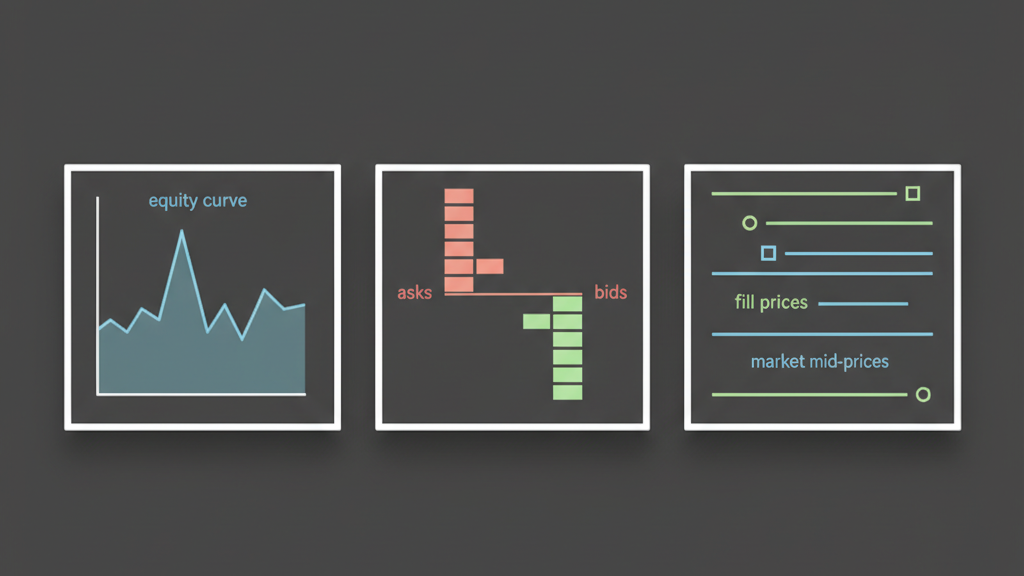
Developing reliable algorithmic trading execution slippage modeling requires moving beyond simplistic assumptions like fixed percentages. While a fixed percentage slippage might be a starting point, it fails to capture the dynamic nature of market microstructure. More advanced models typically incorporate factors like historical tick data, market depth from Level 2 data, and order size, allowing for a more realistic simulation of execution costs. For instance, a common approach involves estimating slippage as a function of order size relative to available liquidity at the order’s desired price, potentially using historical volume-at-price data to project market impact. Implementing these models within a backtesting engine means that instead of assuming a perfect fill at the mid-price, the backtester calculates an adjusted fill price that reflects potential real-world slippage. This ensures that the simulated P&L is a much closer approximation of what a strategy might achieve in live trading.
- Implement historical tick and Level 2 data for dynamic slippage estimates.
- Factor in order size relative to available liquidity at different price levels.
- Utilize market impact models, such as those based on square-root laws, for large order simulation.
- Adjust fill prices post-signal generation in the backtester, not just a flat fee.
Real-Time Slippage Measurement and Performance Attribution
Beyond modeling, effectively identifying and measuring slippage in real-time during live execution is paramount for continuous improvement and risk management. This involves meticulously logging expected execution prices (e.g., mid-price at the exact nanosecond of order submission) against actual fill prices reported by the exchange. The variance provides a concrete metric for realized slippage. However, this is not always straightforward; accurately time-synchronizing market data feeds with execution timestamps across different venues and brokers presents a significant data handling challenge. Moreover, attributing slippage to specific causes – whether it’s network latency, market volatility, or the design of the execution algorithm itself – requires sophisticated analytics. We often build custom dashboards to visualize these real-time metrics, using them to flag underperforming execution venues or to identify patterns that suggest an algorithm’s parameters need recalibration, forming a critical feedback loop for our systems.
Algorithmic Mitigation Techniques for Execution Slippage
Mitigating algorithmic trading execution slippage involves deploying a suite of intelligent algorithms designed to navigate market conditions. Smart Order Routers (SORs) are fundamental, directing orders to venues offering the best price and liquidity at that moment, often considering hidden liquidity. For larger orders, techniques like Iceberg orders break down a significant block into smaller, visible components, reducing immediate market impact, while algorithms like Volume Weighted Average Price (VWAP) or Time Weighted Average Price (TWAP) spread execution over time to minimize price dislocation. Adaptive limit orders also play a role, dynamically adjusting their price based on real-time market movements to improve fill rates without incurring excessive slippage. The choice of technique depends heavily on the order size, desired execution urgency, and prevailing market microstructure, often requiring a trade-off between price improvement and execution speed or certainty.
- Deploy Smart Order Routers (SORs) to access best available liquidity across venues.
- Utilize Iceberg orders to reduce market impact of large block trades.
- Implement VWAP and TWAP algorithms for time-spread execution.
- Employ adaptive limit order strategies to dynamically adjust prices for optimal fills.
Systemic Approaches to Reduce Execution Gaps and Latency
Mitigation isn’t solely about the execution algorithm; it’s also about the entire trading system’s architecture and operational efficiency. Minimizing latency across the whole stack is a powerful slippage mitigation technique. This involves strategic infrastructure decisions such as co-locating servers physically close to exchange matching engines, optimizing network paths with dedicated low-latency lines, and employing hardware acceleration like FPGAs for critical processing tasks. Furthermore, robust API integration with brokers and exchanges, focusing on minimizing overhead and ensuring high throughput, is crucial. Any delays in receiving market data, processing signals, or sending orders can directly translate into missed opportunities or worse fills. Ensuring resilient systems with built-in redundancy and failover mechanisms also prevents execution gaps that can lead to unexpected slippage during market disruptions or API failures.
Integrating Slippage into Risk Management and Strategy Evaluation
The actual cost of algorithmic trading execution slippage must be fully integrated into a strategy’s risk management framework and performance evaluation. Gross P&L figures can be misleading if not adjusted for expected and realized slippage. A strategy might show a positive alpha before accounting for these costs, but turn negative afterward, highlighting its true viability. Quant teams need to define acceptable slippage thresholds as part of their risk parameters, potentially triggering circuit breakers or dynamically reducing position sizes if realized slippage exceeds these limits. Performance evaluation should always present both gross and net P&L, along with slippage per share or per trade metrics, to provide a transparent view of the strategy’s true edge. Regular post-trade analysis, comparing modeled slippage to actual execution outcomes, helps refine both the models and the mitigation techniques, ensuring the system continually learns and adapts to market realities.