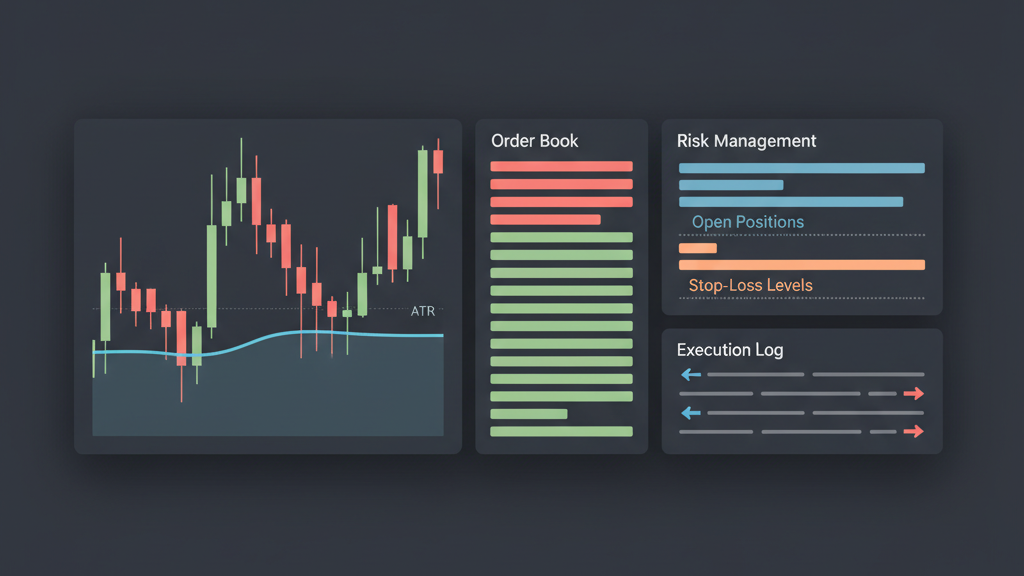
In algorithmic trading, fixed stop-loss levels often fail to adapt to evolving market volatility, leading to premature exits or excessive risk exposure. A more robust approach involves dynamic stop loss placement, which adjusts based on real-time market conditions. The Average True Range (ATR) volatility indicator is a powerful tool for this purpose, providing a quantifiable measure of price volatility that can be directly translated into intelligent stop-loss levels. Integrating an ATR volatility indicator for dynamic stop loss placement allows trading systems to automatically widen stops during volatile periods and tighten them during calmer markets, optimizing the balance between protecting capital and allowing trades room to develop. This adaptive strategy is crucial for building resilient algorithms that can perform across various market regimes.
Understanding ATR as a Volatility Proxy for Stops
The Average True Range (ATR) is a technical indicator that measures market volatility by calculating the average of true ranges over a specified period. Unlike simple range (high-low), the true range accounts for gaps and limits, capturing the full extent of price movement, including potential overnight gaps. For algo trading, ATR is particularly valuable because it quantifies volatility in price terms, providing an objective input for stop-loss calculations. A higher ATR indicates higher volatility, suggesting that a wider stop is necessary to avoid being whipsawed out of a valid trade by normal market noise. Conversely, a lower ATR implies a tighter stop can be justified. This dynamic adjustment is fundamental for developing a stop-loss strategy that isn’t arbitrary but rather informed by the market’s current character, which is a significant step up from using fixed percentage or absolute dollar stops that can be either too tight or too wide depending on the prevailing market environment.
Calculating and Applying ATR to Stop Levels
Implementing an ATR volatility indicator for dynamic stop loss placement involves a few key steps within your script. First, you calculate the True Range for each period, which is the greatest of three values: current high minus current low, current high minus previous close absolute value, or current low minus previous close absolute value. Then, you average these true ranges over a defined look-back period (e.g., 14 periods) to get the ATR. For stop loss, a common approach is to multiply the ATR by a factor (e.g., 2 or 3) and subtract this value from your entry price for a long position, or add it for a short position. For instance, if ATR is $0.50 and your multiplier is 2, your stop would be $1.00 away from your entry. The choice of multiplier is critical and often determined through extensive backtesting, as it directly impacts your trade-off between giving a trade room and protecting capital.
- Define a look-back period for ATR (e.g., 10, 14, 20 periods).
- Calculate True Range: Max[(High – Low), Abs(High – Previous Close), Abs(Low – Previous Close)].
- Compute the Exponential Moving Average (EMA) or Simple Moving Average (SMA) of True Ranges for ATR.
- Determine a suitable ATR multiplier (e.g., 2x ATR, 3x ATR) based on asset and strategy.
- Set initial stop-loss: Entry Price – (ATR * Multiplier) for long, Entry Price + (ATR * Multiplier) for short.
Integrating Dynamic Stops into Trading Workflows
Integrating ATR-based stops into an algorithmic trading workflow requires robust logic for both initial placement and subsequent adjustments. Upon trade entry, the system calculates the current ATR and places the initial stop order. For trailing stops, the ATR calculation needs to be continuously updated, and the stop-loss level adjusted only in the profitable direction. This dynamic adjustment must be handled carefully to avoid excessive API calls or rapid stop movements that could incur high transaction costs. Consider implementing a buffer or a minimum move threshold before adjusting a trailing stop to reduce noise. Furthermore, the system must account for scenarios where a new bar’s ATR calculation might significantly widen the stop, potentially exposing more capital than initially intended. Robust risk management checks should always accompany any dynamic stop placement to ensure positions remain within acceptable risk parameters, even with volatility changes.
Backtesting Considerations for ATR Stop Strategies
Effective backtesting of a strategy using the ATR volatility indicator for dynamic stop loss placement goes beyond simply running historical data. It demands careful attention to data quality, particularly accurate historical high, low, and close prices, as ATR relies heavily on these. Look-ahead bias is a critical pitfall to avoid; ensure that your ATR calculation at any point in time only uses data that would have been available historically. Simulating slippage and execution latency is also paramount, as dynamically adjusting stops often means sending new orders to the market, which might not fill precisely at the calculated price, especially in fast-moving conditions. Evaluate performance metrics such as average win/loss ratio, maximum drawdown, and profit factor, not just overall profit, to understand the strategy’s true robustness under various market conditions. Test across different market cycles – trending, ranging, high volatility, low volatility – to assess the adaptability of your chosen ATR period and multiplier.
- Ensure historical data quality for accurate True Range and ATR calculations.
- Strictly avoid look-ahead bias by only using historical data for ATR computation.
- Account for simulated slippage and execution latency, especially for dynamic stop adjustments.
- Evaluate strategy performance across diverse market regimes (trending, ranging, volatile).
- Analyze key metrics: profit factor, maximum drawdown, average trade P&L, and win rate.
Execution Challenges and Contingencies
While the theory of using an ATR volatility indicator for dynamic stop loss placement is sound, real-time execution introduces several complexities. Latency between your system’s ATR calculation, stop adjustment logic, and the broker’s API can lead to ‘stale’ stop prices. If market conditions change rapidly, a new stop order might not be processed before the price blows past your intended level, resulting in larger losses than anticipated. API rate limits also factor in; frequent stop updates, particularly across many concurrent positions, can hit limits and cause order rejections. Contingency planning is crucial: implement logic to handle API failures, rejections, or situations where a stop order is placed but not immediately confirmed. This might involve secondary, fixed emergency stops or logic to temporarily suspend dynamic adjustments during extreme market events until the system can regain stable communication with the exchange. Reliable logging and monitoring of stop-loss order status are non-negotiable for understanding real-world performance versus backtested results.
Risk Management and Position Sizing Integration
Beyond individual trade protection, the ATR volatility indicator for dynamic stop loss placement plays a significant role in holistic risk management and position sizing. Since the ATR-derived stop distance varies, a fixed position size could expose inconsistent capital risk per trade. A more advanced approach integrates ATR into position sizing: by determining the acceptable risk per trade (e.g., 1% of capital), you can use the ATR-derived stop distance to calculate the maximum number of shares or contracts to trade. If the ATR indicates a wide stop, your position size will be smaller, ensuring that the monetary risk remains constant. This dynamic position sizing, often referred to as ‘volatility-adjusted position sizing,’ aligns the capital at risk with the market’s current volatility, leading to a more consistent equity curve and better overall portfolio risk control. Without this integration, the benefits of dynamic stops can be undermined by inconsistent per-trade risk exposures, making portfolio-level risk management much harder to predict or control.