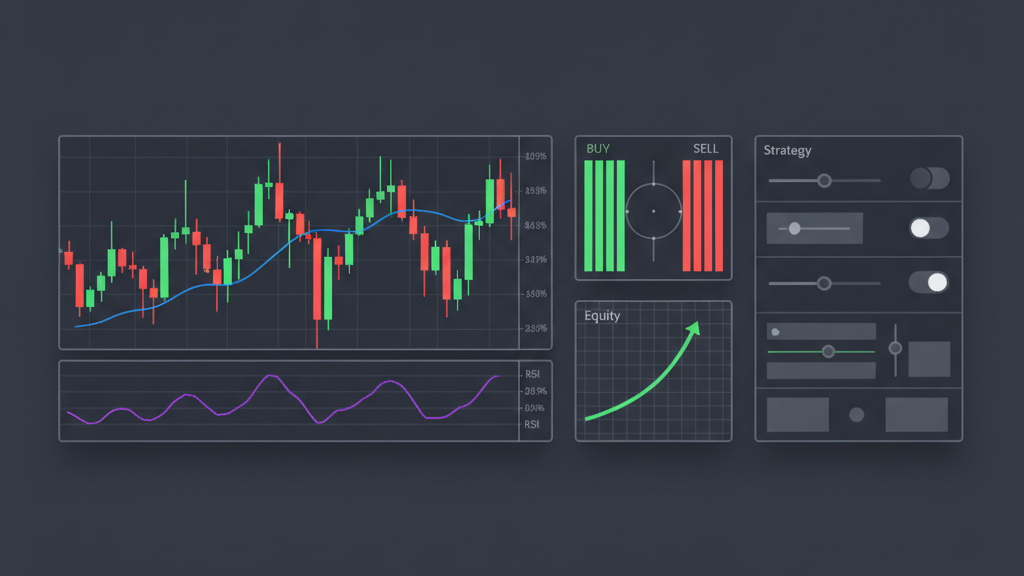
Developing robust automated trading strategy for systematic backtesting is a critical endeavor for any serious quantitative trader or institutional desk. The process extends beyond merely conceptualizing a trading idea; it involves meticulous data preparation, rigorous rule definition, comprehensive backtesting, and diligent risk management. A well-constructed strategy, validated through systematic backtesting, minimizes the risk of deploying underperforming or erroneous logic in live markets. This guide outlines the fundamental stages and best practices involved in building high-quality algorithmic strategies that withstand the complexities of real-world trading conditions. By following these principles, traders can significantly enhance the reliability and performance potential of their automated systems, ensuring they are prepared for diverse market environments and capable of sustained profitability. We focus on a practical, step-by-step approach to ensure thoroughness and precision throughout the development cycle, emphasizing the importance of a data-driven methodology.
1. Defining Clear Strategy Objectives and Scope
Before any code is written or data is analyzed, clearly defining the strategy’s objectives is paramount. This initial phase involves articulating the core purpose of the automated trading strategy, whether it is to achieve consistent alpha, arbitrage opportunities, or specific market-making goals. Establishing the target market, permissible instruments, and anticipated holding periods helps narrow the focus and inform subsequent development decisions. Furthermore, setting realistic profit targets and defining acceptable risk parameters, such as maximum drawdown or daily loss limits, provides crucial boundaries for design and evaluation. A well-defined scope ensures that development efforts remain aligned with overarching trading goals, preventing scope creep and the creation of overly complex or ill-suited strategies. This foundational step dictates the data requirements, the types of indicators to consider, and the overall architecture of the automated system, establishing a clear roadmap for success.
- Articulate precise trading goals and expected outcomes.
- Identify target markets, asset classes, and timeframes for the strategy.
- Define specific risk tolerance levels and capital allocation limits.
- Establish clear benchmarks for success and failure criteria.
- Document expected market conditions the strategy is designed for.
2. Data Acquisition and Preprocessing for Systematic Backtesting
High-quality historical data forms the bedrock of systematic backtesting. The accuracy and reliability of any backtest are directly proportional to the integrity of the data used. This stage involves sourcing comprehensive tick, minute, or daily bar data, ensuring it is free from errors, gaps, and survivorship bias. Data must be meticulously cleaned to remove outliers, correct timestamps, and handle corporate actions like stock splits or dividends accurately. Selecting appropriate data vendors and understanding their data methodologies is crucial for consistency. Preprocessing also includes normalizing data, handling currency conversions if necessary, and ensuring proper alignment across multiple instruments. Flawed data can lead to misleading backtest results, giving a false sense of security or wrongly dismissing a potentially viable strategy, thereby undermining the entire development effort before it even reaches the validation stage. Robust data pipelines are essential for scalable and accurate testing.
- Source high-fidelity historical data from reputable vendors.
- Clean data rigorously, addressing missing values and outliers.
- Adjust for corporate actions (splits, dividends) to maintain integrity.
- Synchronize timestamps across all data series precisely.
- Validate data against known market events and benchmarks.
3. Strategy Design and Rule Development
Translating a trading idea into executable code requires a structured approach to rule development. This stage involves defining precise entry and exit conditions based on technical indicators, price action, volume analysis, or fundamental triggers. Rules must be unambiguous and quantifiable, allowing for consistent application across historical data. Considerations for position sizing, order types (market, limit, stop), and time-in-force also come into play here. It is often beneficial to start with simpler logic and gradually introduce complexity, rather than over-engineering from the outset. Documenting the strategy logic with flowcharts or pseudo-code can significantly improve clarity and facilitate collaboration. A well-defined set of rules forms the algorithm’s intelligence, dictating every trading decision, and ensuring the strategy operates exactly as intended without human intervention or subjective interpretation, which is key to automation and systematic testing accuracy.
- Develop precise, unambiguous entry and exit conditions.
- Define clear rules for position sizing and capital allocation.
- Specify order types and execution logic within the strategy.
- Incorporate conditional logic for varying market environments.
- Modularize strategy components for easier testing and iteration.
4. Implementing the Systematic Backtesting Framework
The backtesting framework is the engine that validates a strategy’s historical performance. This involves integrating the designed strategy rules with the cleaned historical data within a robust backtesting platform. The framework must accurately simulate market conditions, including factors like slippage, commissions, and order execution delays, to provide realistic performance estimates. Essential components include an event-driven engine that processes data chronologically and a simulation environment that tracks portfolio equity, positions, and cash flows. Proper implementation ensures that the backtest reflects potential real-world trading as closely as possible, identifying strengths and weaknesses. This systematic approach allows for objective evaluation and iterative refinement, moving beyond subjective intuition to data-driven conclusions about a strategy’s viability. The quality of this implementation directly impacts the confidence one can place in the backtested results and subsequent live deployment.
- Select a reliable and feature-rich backtesting platform.
- Integrate strategy rules with the backtesting engine for simulation.
- Accurately model transaction costs, slippage, and market impact.
- Implement an event-driven backtesting architecture.
- Ensure realistic order execution and fill logic simulation.
5. Performance Metrics and Robustness Evaluation
Evaluating an automated trading strategy goes far beyond simple net profit. A comprehensive assessment requires analyzing a suite of performance metrics that provide insight into risk-adjusted returns and strategy stability. Key indicators include Sharpe Ratio, Sortino Ratio, Maximum Drawdown, Profit Factor, Win Rate, and Average Trade P&L. Understanding these metrics helps identify if the strategy’s returns are commensurate with its risk and if its performance is consistent. Furthermore, robustness evaluation involves stress-testing the strategy across different market regimes, varying parameters slightly, and analyzing sensitivity to ensure it does not break down under adverse conditions. This critical phase prevents the deployment of strategies that might appear profitable on paper but are fragile in live trading. A thorough evaluation helps distinguish between genuinely robust strategies and those that merely fit historical data well without predictive power, which is a common pitfall in algo development.
- Analyze key performance indicators (KPIs) like Sharpe and Sortino Ratios.
- Evaluate maximum drawdown and time under water.
- Assess profit factor, win rate, and average trade profitability.
- Conduct stress tests under simulated adverse market conditions.
- Perform sensitivity analysis on key strategy parameters.
6. Mitigating Overfitting and Data Snooping Bias
Overfitting occurs when a strategy is too closely tailored to historical data, performing exceptionally well in backtests but failing in live markets. Data snooping bias arises from repeatedly testing strategies on the same data, inadvertently finding patterns that are not statistically significant. Mitigating these biases is crucial for a truly robust automated trading strategy. Techniques such as walk-forward optimization, where parameters are optimized on an in-sample period and then tested on a subsequent out-of-sample period, are highly effective. Using Monte Carlo simulations to evaluate performance across a range of possible market paths also adds a layer of robustness. Furthermore, ensuring that a significant portion of historical data is reserved strictly for out-of-sample testing, unseen during the optimization phase, is a fundamental practice. These methods help confirm that a strategy’s success is due to underlying market logic rather than mere curve-fitting.
- Utilize walk-forward optimization for parameter validation.
- Reserve a dedicated out-of-sample data set for final validation.
- Employ Monte Carlo simulations to assess strategy robustness.
- Avoid excessive parameter optimization or curve-fitting.
- Perform cross-validation techniques to generalize strategy performance.
7. Integrating Comprehensive Risk Management and Execution Logic
A robust automated trading strategy is incomplete without comprehensive risk management. This involves more than just setting stop-loss orders; it encompasses dynamic position sizing, maximum daily or weekly loss limits, circuit breakers, and overall portfolio exposure controls. The strategy must be designed to react to unexpected market events, potential technical failures, and predefined risk thresholds. Execution logic also plays a critical role, addressing issues like slippage, latency, and order rejection. Integrating robust error handling and retry mechanisms ensures that the strategy can recover from minor technical glitches without human intervention. Furthermore, strategies should account for the impact of large orders on market prices and adapt execution accordingly. Proactive risk controls prevent catastrophic losses and preserve capital, making the difference between a volatile, short-lived system and a stable, sustainable one. This integration provides a crucial layer of defense for automated operations.
- Implement dynamic stop-loss and take-profit mechanisms.
- Enforce strict maximum drawdown and daily loss limits.
- Integrate capital preservation rules and position sizing algorithms.
- Account for slippage, latency, and market impact in execution.
- Develop robust error handling and system health monitoring.
8. Iterative Refinement and Continuous Monitoring
Developing robust automated trading strategy for systematic backtesting is not a one-time event; it is an iterative and ongoing process. Even after successful backtesting and initial live deployment, continuous monitoring is essential. Market dynamics evolve, and a strategy that performed well yesterday may become less effective tomorrow. Regular review of live performance against backtest expectations helps identify potential drifts or regime changes. Strategies may require periodic recalibration or adaptation to new market conditions, informed by ongoing data analysis and real-time feedback. Implementing A/B testing in a controlled live environment (e.g., paper trading or small-scale live) can provide further validation before full deployment. Establishing alerts for unusual performance or technical issues ensures timely intervention. This commitment to iterative improvement and vigilant oversight ensures that the automated strategy remains relevant, efficient, and profitable over its operational lifespan, adapting to an ever-changing financial landscape.
- Establish continuous monitoring of live strategy performance.
- Regularly compare live results with backtest expectations.
- Implement mechanisms for periodic strategy recalibration.
- Prepare for strategy adaptation to changing market regimes.
- Set up alerts for performance degradation or technical issues.