In the fast-paced world of algorithmic trading, developing sophisticated strategies is only one part of the equation. The true test of an algo’s efficacy and resilience lies in its live performance. Even the most thoroughly backtested strategy can falter in real-market conditions due to unforeseen variables, infrastructure issues, or subtle shifts in market microstructure. Therefore, ensuring sustained profitability requires vigilant monitoring live execution performance: critical metrics for algo trading success are paramount. This proactive approach allows traders to identify anomalies, mitigate risks, and make informed adjustments swiftly, safeguarding capital and maximizing returns in an environment where milliseconds can translate into significant gains or losses.
The Imperative of Real-time Performance Monitoring
Real-time performance monitoring is not merely a best practice; it is a fundamental requirement for successful algorithmic trading operations. Without immediate insights into how an algo is performing in the live market, traders operate blind, exposed to potentially catastrophic losses from malfunctioning strategies or unexpected market events. The dynamic nature of financial markets demands constant vigilance, as latency spikes, data feed interruptions, or sudden liquidity shifts can severely impact an algo’s intended behavior. Implementing robust monitoring systems provides the necessary visibility to detect these issues early, enabling rapid intervention and protecting capital. It transforms reactive problem-solving into proactive risk management, ensuring strategies continue to align with their designed objectives under actual trading conditions.
- Detect anomalies and deviations from expected behavior instantly.
- Prevent significant capital erosion due to unforeseen market conditions.
- Validate strategy assumptions against real-time market dynamics.
- Maintain system integrity and operational continuity.
- Respond swiftly to infrastructure failures or connectivity issues.
- Optimize strategy parameters based on live feedback.
Key Performance Indicators for Execution Quality
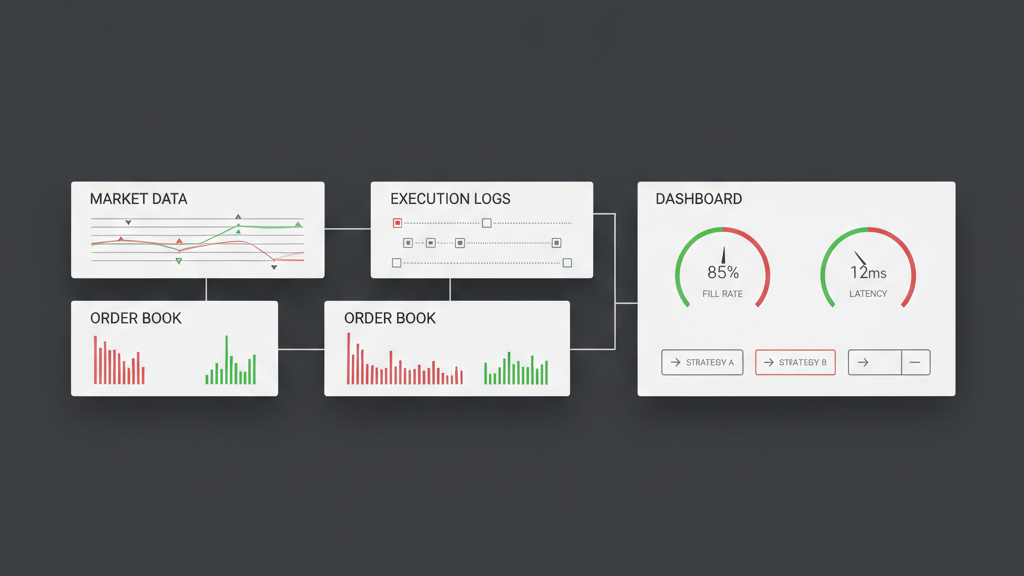
Evaluating the quality of trade execution is central to understanding an algo’s true performance. Metrics such as slippage, fill rate, latency, and market impact directly reflect how effectively an algo interacts with the market. Slippage measures the difference between the expected price of a trade and its actual execution price, indicating market liquidity and order impact. The fill rate determines the percentage of submitted orders that are successfully executed, crucial for strategies requiring high order completion. Latency, the delay between sending an order and its reception by the exchange, affects competitiveness. Market impact quantifies how an algo’s own trades influence price, an essential consideration for larger orders. Tracking these KPIs provides a clear picture of execution efficiency and identifies areas for optimization.
- Monitor slippage to quantify price deviation from intent.
- Track fill rate to ensure high order completion success.
- Measure end-to-end latency for competitive execution speed.
- Assess market impact to understand order footprint.
- Analyze execution costs, including commissions and fees.
- Evaluate spread capture for market-making strategies.
Strategy-Specific Metrics and Profitability Analysis
Beyond general execution quality, algorithmic traders must closely track metrics directly indicative of their strategy’s financial health. Realized Profit and Loss (P&L) is the most direct measure of success, but it needs context. Maximum drawdown identifies the largest peak-to-trough decline in capital, revealing risk exposure. The Sharpe ratio provides a risk-adjusted return, offering a more nuanced view of profitability relative to volatility. The win rate, along with average win and loss sizes, helps characterize the strategy’s edge. By combining these metrics, traders can assess if their strategy is performing as expected, generating consistent returns, and managing risk effectively in a live environment. Continuous evaluation of these indicators is vital for long-term viability.
- Track real-time P&L to gauge immediate financial performance.
- Monitor current and maximum drawdown to assess capital risk.
- Calculate live Sharpe ratio for risk-adjusted return analysis.
- Analyze win rate and average trade size for strategy efficacy.
- Evaluate capital utilization and return on capital invested.
- Observe daily, weekly, and monthly performance trends.
System Health and Operational Stability
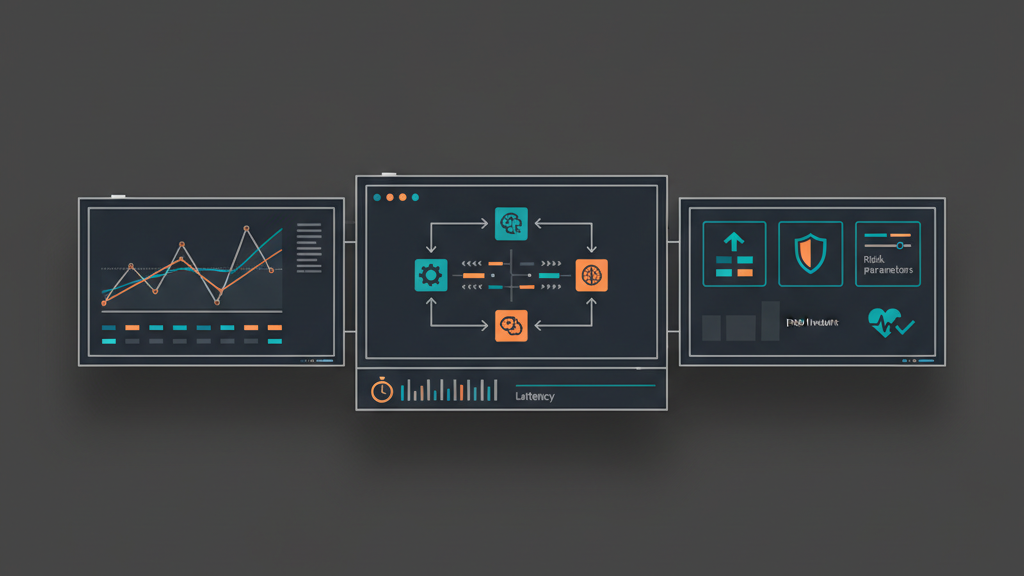
The underlying infrastructure supporting algorithmic trading is just as critical as the strategy itself. Operational stability metrics ensure that the trading environment is robust and reliable. This includes monitoring server uptime, network connectivity latency, and the integrity of data feeds. Any disruption in these areas can lead to missed opportunities, erroneous trades, or complete system failures. Error rates in order submission or data processing also highlight potential software bugs or integration issues. Proactive monitoring of system health ensures that the technological foundation remains solid, allowing the trading algorithms to operate without environmental constraints. This attention to infrastructure minimizes operational risks and enhances overall system reliability, contributing directly to consistent performance.
- Monitor server uptime and resource utilization (CPU, memory).
- Track network latency to exchanges and data providers.
- Validate data feed integrity against redundant sources.
- Log and analyze all system errors and warnings.
- Ensure robust backup and disaster recovery mechanisms.
- Verify synchronized time across all trading components.
Dynamic Risk Management and Controls
Effective risk management is paramount when monitoring algo execution performance. Automated risk controls act as a crucial safety net, preventing runaway losses in volatile or unexpected market conditions. These controls include granular position limits, dynamic stop-loss triggers, daily loss limits, and emergency circuit breakers. Position limits restrict exposure to any single asset or strategy, while dynamic stop-losses adapt to market movements, protecting profits or minimizing losses. Daily loss limits provide an overarching boundary for strategy performance, and circuit breakers offer an immediate ‘kill switch’ for the entire system if predefined critical thresholds are breached. Implementing and continuously monitoring these controls ensures that even in adverse scenarios, capital is protected according to predefined risk tolerances, maintaining overall portfolio stability.
- Set and enforce strict position sizing and capital allocation limits.
- Implement dynamic stop-loss and take-profit thresholds.
- Monitor real-time exposure across all open positions.
- Establish daily, weekly, and monthly maximum drawdown limits.
- Develop circuit breakers for automatic strategy termination.
- Ensure regulatory compliance and adherence to internal risk policies.
Alerting and Automated Response Mechanisms
Even with sophisticated monitoring, human intervention can be too slow for the speed of algorithmic trading. This necessitates robust alerting and automated response mechanisms. Setting up threshold-based alerts ensures that traders are notified immediately of any critical deviations, such as excessive slippage, unexpected drawdowns, or system errors. Beyond notifications, automated responses can include pausing strategies, reducing position sizes, or even fully exiting positions based on predefined conditions. These automated actions prevent minor issues from escalating into significant problems, providing an immediate layer of defense. Such systems allow for continuous operation with a safety net, ensuring prompt action even when human oversight is temporarily diverted, thereby enhancing the overall resilience of the trading operation.
- Configure real-time alerts for critical performance deviations.
- Utilize multi-channel notifications (email, SMS, dashboard).
- Automate strategy pausing or de-risking based on thresholds.
- Implement fail-safe mechanisms for infrastructure failures.
- Provide clear manual override protocols for urgent situations.
- Log all alerts and automated actions for post-mortem analysis.
Post-Execution Analysis and Continuous Improvement
While real-time monitoring is crucial for immediate risk mitigation, comprehensive post-execution analysis is vital for long-term strategy improvement. Every piece of live execution data, including fills, rejections, market data anomalies, and system logs, holds valuable insights. Aggregating and analyzing this data retrospectively allows traders to identify subtle patterns, uncover hidden inefficiencies, and fine-tune their algorithms. This involves comparing live performance against backtested expectations, dissecting individual trade outcomes, and reviewing the effectiveness of risk controls. By continually refining strategies based on actual market interactions, quantitative teams can iteratively enhance their algorithms, adapt to evolving market conditions, and sustain a competitive edge. This iterative process of monitoring, analysis, and refinement is fundamental to achieving enduring algo trading success.
- Collect and aggregate all live execution and market data.
- Perform detailed transaction cost analysis (TCA).
- Compare live performance metrics against backtesting results.
- Identify recurring issues or performance bottlenecks.
- Refine strategy parameters based on empirical observations.
- Document changes and conduct A/B testing for new iterations.