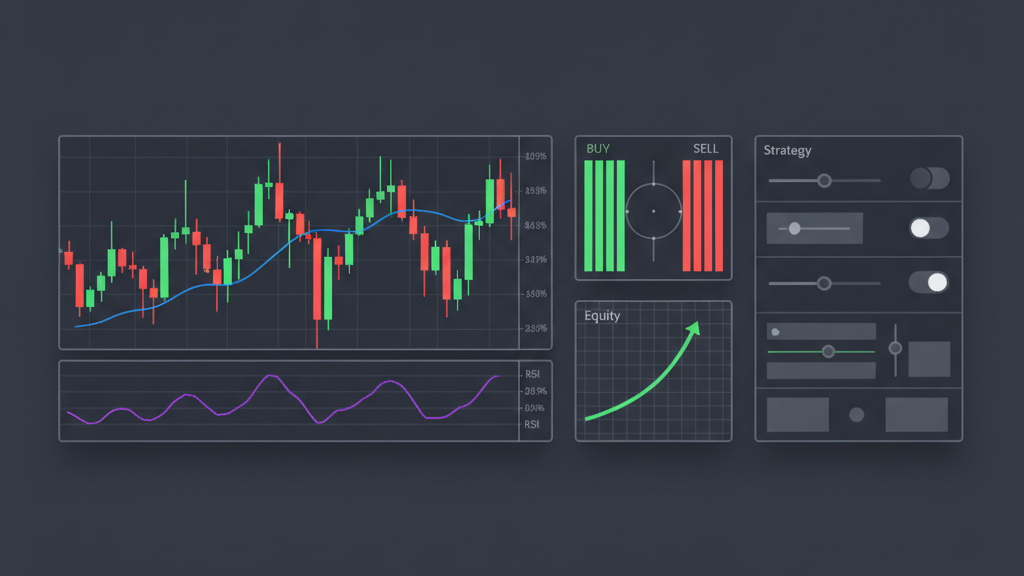
Developing profitable algorithmic trading strategies requires rigorous validation. At the core of this validation is backtesting, the process of testing a strategy on historical data to evaluate its performance. However, relying solely on generic backtesting platforms can introduce inaccuracies, leading to misleading results and potential losses in live markets. This underscores the critical need for custom trading script development for precise backtesting of new algo strategies. Custom scripting provides the flexibility to simulate specific market conditions, integrate unique data sources, and meticulously control every aspect of a strategy’s execution and evaluation. By investing in tailored backtesting solutions, quantitative teams can gain a more accurate understanding of their strategy’s true potential and inherent risks before committing real capital.
The Role of Custom Scripting in Backtesting Accuracy
Generic backtesting platforms often provide a good starting point, but they rarely offer the granularity and customization required for high-frequency or complex algorithmic strategies. Custom trading script development allows for an unparalleled level of control over the simulation environment. This includes the ability to model specific exchange behaviors, account for nuanced market microstructures like order book dynamics or specific latency profiles, and precisely integrate proprietary data sets. When a strategy relies on unique indicators or specific execution logic, a bespoke script ensures that the backtest accurately reflects these conditions, reducing the ‘reality gap’ between simulated and live performance. This precision is fundamental for making informed decisions about strategy deployment.
- Integrate custom data sources and proprietary indicators.
- Model specific market microstructures and order book dynamics.
- Simulate various latency and slippage scenarios accurately.
- Implement complex conditional logic beyond standard platforms.
- Ensure exact replication of intended strategy execution.
Data Management and Preprocessing for Robust Tests
The accuracy of any backtest is directly tied to the quality of the historical data used. Developing scripts for data management is crucial for ensuring that this foundation is sound. This involves scripting processes for sourcing high-quality tick or minute data, handling corporate actions like stock splits or dividends, cleaning noisy data, and correcting for common biases such as survivorship bias or look-ahead bias. Proper data normalization and time synchronization across multiple assets are also critical. A robust data pipeline, built with custom scripts, guarantees that the backtesting environment operates on a realistic and unbiased representation of past market conditions, which is essential for developing reliable algo strategies.
- Source and clean high-resolution historical market data.
- Implement bias mitigation techniques (survivorship, look-ahead).
- Normalize and synchronize multi-asset time series data.
- Handle corporate actions and data adjustments automatically.
- Validate data integrity through automated checks.
Architecting Event-Driven Backtesting Environments
A key aspect of precise backtesting is the architecture of the backtesting engine itself. Event-driven backtesters, built through custom script development, process market data events sequentially, mimicking real-time market flow more accurately than vectorized backtesters. This allows for precise simulation of order placement, fills, cancellations, and the impact of market liquidity. Custom scripts can integrate detailed models for slippage, commission structures, and even network latency, which are often overlooked or oversimplified in off-the-shelf tools. Designing a modular and scalable backtesting environment ensures that new strategies can be tested efficiently and that the system can adapt to evolving market complexities, providing a solid foundation for robust algo strategy development.
- Design event-driven backtesting engines for realism.
- Simulate order execution with accurate slippage and commissions.
- Model market depth and liquidity effects precisely.
- Incorporate network latency and execution delays.
- Develop modular components for easy strategy integration.
Implementing Strategy Logic within Scripts
Translating a theoretical trading idea into executable code for backtesting requires careful scripting. This involves using programming languages like Python or C++ to define entry and exit signals, position sizing rules, stop-loss, and take-profit mechanisms. Custom scripts offer the flexibility to implement highly complex, multi-factor strategies that might be difficult or impossible with drag-and-drop interfaces. Emphasis should be placed on writing clear, maintainable, and efficient code. The script development process also involves creating robust parameter optimization frameworks, allowing quantitative teams to systematically test various input values to identify optimal strategy settings. This iterative process of coding and optimization is central to refining algo strategies.
- Translate strategy concepts into executable, robust code.
- Implement custom indicators and complex trading rules.
- Develop dynamic position sizing and risk management logic.
- Build frameworks for efficient parameter optimization.
- Ensure code performance for rapid backtesting cycles.
Performance Metrics and Statistical Validation
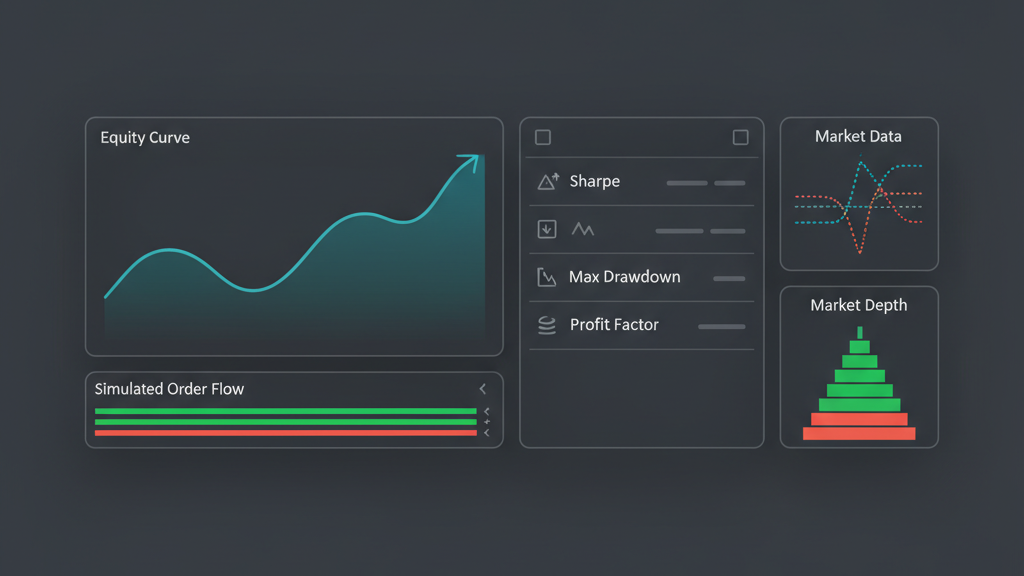
Beyond basic profit and loss, comprehensive backtesting requires a deep analysis of various performance metrics and statistical validation. Custom trading scripts can calculate an extensive range of metrics, including Sharpe Ratio, Sortino Ratio, maximum drawdown, profit factor, Calmar Ratio, and various risk-adjusted returns. Importantly, scripts allow for the implementation of statistical tests to assess the significance and robustness of the results. This includes techniques like Monte Carlo simulations to understand the variability of outcomes under different market sequences, and walk-forward optimization to combat overfitting. Rigorous statistical validation through custom scripting helps confirm that a strategy’s historical performance is not merely a result of chance or data-mining bias.
- Calculate a broad spectrum of risk and return metrics.
- Perform Monte Carlo simulations for robustness checks.
- Implement statistical tests for significance of results.
- Analyze drawdown characteristics and recovery periods.
- Develop custom visualization tools for performance insights.
Iteration, Refinement, and Transition to Live Trading
Backtesting is an iterative process. Initial results often highlight areas for improvement, requiring continuous refinement of the strategy logic, parameters, or even the underlying data. Custom trading script development facilitates this iterative cycle by providing a flexible framework for making rapid adjustments and re-running tests. Once a strategy demonstrates consistent robustness in backtests, the scripts can be adapted for forward testing (paper trading) in real-time environments. This crucial step bridges the gap between simulated historical performance and live market conditions, allowing for validation of execution logic and risk controls without deploying real capital. This careful transition ensures readiness for actual market deployment.
- Facilitate rapid iteration and refinement of strategy logic.
- Conduct forward testing (paper trading) with live data feeds.
- Adapt backtesting scripts for seamless transition to execution systems.
- Integrate real-time data handling and order management.
- Establish monitoring and alert systems for live operation.
Mitigating Common Backtesting Pitfalls
Several common pitfalls can undermine the validity of backtesting results. These include overfitting, where a strategy performs exceptionally well on historical data but fails in live trading, and look-ahead bias, which occurs when future information inadvertently influences past decisions. Survivorship bias, where only data from successful assets is included, can also distort results. Custom trading script development allows quantitative teams to consciously design their backtesting processes to explicitly mitigate these risks. By implementing strict data handling protocols, rigorous out-of-sample testing, and walk-forward validation methodologies, scripts ensure that the backtest provides a realistic and unbiased assessment of the strategy’s potential, protecting against misleading performance claims.
- Implement techniques to prevent overfitting strategies.
- Design scripts to avoid look-ahead bias in data processing.
- Account for survivorship bias in historical asset data.
- Utilize walk-forward optimization for true out-of-sample testing.
- Establish strict validation and verification protocols.