In automated trading, the speed at which orders are processed and executed directly impacts profitability, especially in high-frequency environments. Reducing automated trading execution latency for live markets isn’t just about faster hardware; it’s a comprehensive engineering challenge spanning infrastructure, software architecture, operating system configuration, and network protocols. Every microsecond saved can translate into a significant competitive advantage, reducing slippage and increasing the probability of capturing fleeting market opportunities. This article will explore practical strategies and considerations for minimizing execution latency, drawing from real-world experience in building and operating robust trading systems.
Understanding the Latency Landscape in Live Trading
When we talk about automated trading execution latency, it’s crucial to disaggregate the total delay into its constituent parts. This isn’t a monolithic problem; it’s a chain of events, each with its own potential for bottlenecks. We’re looking at network latency from your execution engine to the exchange, which itself involves physical cable lengths, router hops, and switch propagation delays. Then there’s system latency, covering the time taken for your trading application to generate an order, pass it through the operating system’s network stack, and finally serialize it. Exchange-side matching engine latency, while often outside our direct control, is a critical component to understand for realistic performance expectations and slippage calculations. Finally, data ingestion latency – the time it takes to receive and process market data – directly affects signal generation and order placement timing, meaning that even a perfectly optimized execution path can be undermined by slow or noisy input data.
Infrastructure Optimization: The Physical Edge
Achieving top-tier automated trading execution latency often starts with physical proximity to the exchange’s matching engine. Co-location is almost a prerequisite in competitive low-latency trading, as it drastically reduces network hop count and cable length. Beyond location, the choice of network interface cards (NICs) is critical; specialized FPGA-based NICs or those supporting kernel bypass technologies like Solarflare’s OpenOnload or Mellanox’s VMA can shave off significant microseconds by allowing user-space applications to directly access the network hardware, bypassing the OS kernel entirely. High-performance, low-latency switches and direct fiber optic connections within the co-lo facility further ensure that network-induced delays are minimized. Our architecture decisions here directly influence the lower bound of achievable latency before any software even runs.
- Co-location services for direct physical proximity to exchange matching engines.
- Specialized network interface cards (NICs) with kernel bypass capabilities (e.g., Solarflare, Mellanox).
- High-throughput, low-latency network switches and direct fiber connectivity within the data center.
- Hardware time synchronization via PTP (Precision Time Protocol) for accurate timestamping across components.
Code-Level Performance and Language Selection
Software efficiency is paramount once the infrastructure is optimized. C++ remains the dominant language for critical path components due to its fine-grained control over memory and CPU cycles. We meticulously profile code using tools like `perf` or Intel VTune to identify hotspots and optimize algorithms. This involves minimizing memory allocations, preferring stack allocations where possible, and utilizing efficient data structures like lock-free queues for inter-thread communication to avoid contention. Modern C++ features, when used judiciously, can enhance performance, but the focus is always on avoiding overhead. Even seemingly minor details, like cache line alignment or branch prediction friendliness, can yield measurable improvements in execution speed for our automated trading systems. Every instruction cycle counts when aiming for single-digit microsecond latencies.
Operating System and Kernel Tuning
The operating system, particularly Linux, needs careful tuning to support low-latency automated trading. Standard kernel configurations are not designed for the extreme demands of HFT. We disable CPU frequency scaling, C-states, and EIST to ensure consistent clock speeds and prevent latency spikes. IRQ affinities are set to dedicate specific CPU cores to critical network interrupt handling, while trading application threads are pinned to other isolated cores to minimize context switching and avoid interference from background OS processes. Using a real-time kernel patchset (like PREEMPT_RT) can reduce jitter, though kernel bypass solutions often offer more significant gains for network-bound tasks. The goal is to create as deterministic an environment as possible, ensuring that our trading application gets uninterrupted access to resources.
- Disable CPU frequency scaling, C-states, and EIST for consistent performance.
- Pin critical threads and IRQ handlers to specific CPU cores using `taskset` and `irqbalance`.
- Utilize real-time kernel patches (e.g., PREEMPT_RT) to reduce scheduling jitter.
- Optimize kernel network parameters like `net.core.busy_poll` and `net.core.netdev_max_backlog`.
Exchange Connectivity and API Efficiency
Interfacing with exchange APIs is a critical point for automated trading execution latency. While FIX protocol is standard, its text-based nature introduces serialization and parsing overhead. Many exchanges offer binary protocols or direct memory access (DMA) interfaces for their low-latency feeds and order entry, which are significantly faster. Implementing these requires careful byte-level manipulation and understanding of network packet structures. Even with FIX, optimizing the client-side implementation – pooling connections, minimizing session establishment overhead, and efficient message serialization/deserialization – is vital. Robust error handling and retransmission logic are essential but must be implemented with minimal performance impact, as retransmissions themselves are a source of latency that can disrupt an otherwise smooth execution path. The details of how your system interacts with the exchange’s specific interfaces can be a major differentiator.
Proactive Latency Monitoring and Measurement
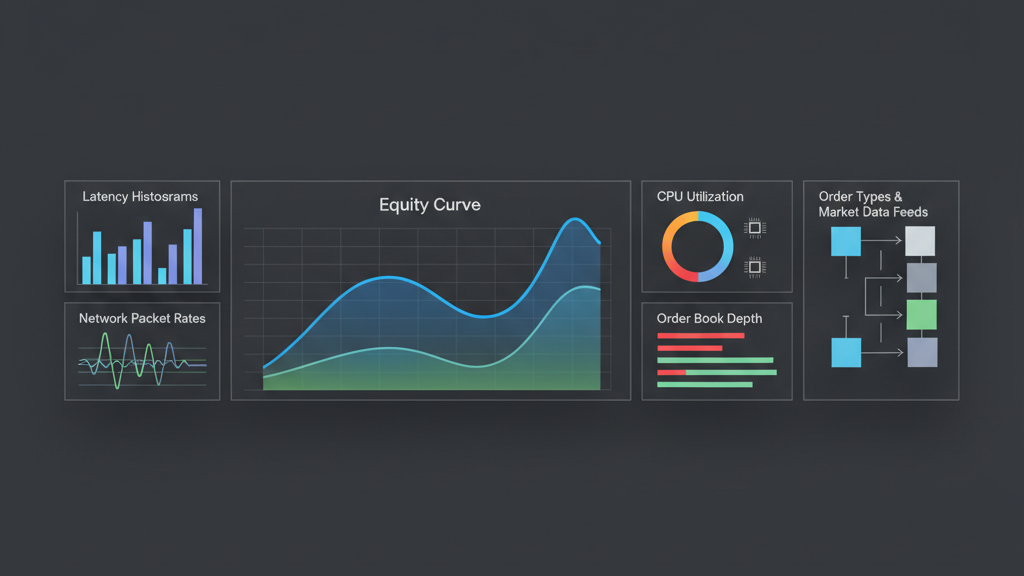
You can’t optimize what you can’t measure, and this holds especially true for automated trading execution latency. Implementing comprehensive, real-time latency monitoring is non-negotiable. This involves instrumenting every critical path in your system: market data ingestion time, signal generation time, order construction time, network send time, and exchange acknowledgment time. High-resolution timers (like `rdtsc` on Linux) are used for nanosecond-level precision. Aggregated statistics like mean, median, 95th, and 99th percentile latencies provide a clearer picture than just averages. Automated alerts triggered by significant deviations from baselines help detect infrastructure degradation or software regressions immediately. This monitoring data is crucial for continuous improvement, allowing us to pinpoint new bottlenecks as market conditions or system changes evolve, and to quickly debug any performance anomalies in a live environment. Backtesting alone won’t expose these live-system latencies.
- Granular instrumentation of all critical path components using high-resolution timers.
- Real-time dashboards displaying mean, median, and percentile latency metrics.
- Automated alerting for latency spikes or sustained increases.
- Log correlation across services using distributed tracing IDs to track order lifecycle latency.
- Synthetic order path monitoring to measure end-to-end latency independently of live trading.
Mitigating Latency-Induced Execution Gaps and Risks
Even with significant latency optimization efforts, residual latency will always exist, leading to potential execution gaps like slippage, partial fills, or stale market data. Our automated trading systems must be designed to anticipate and manage these. Advanced order types, such as icebergs or pegged orders, can help minimize market impact, though they introduce their own complexities. Smart order routing logic can direct orders to venues with better liquidity or lower latency characteristics. Crucially, robust risk management logic must account for these execution uncertainties. This includes setting strict price limits, implementing maximum slippage tolerances, and incorporating circuit breakers that halt trading if actual execution prices consistently deviate too far from expected values. Acknowledging that perfect zero-latency execution is a myth allows us to build more resilient and realistic trading strategies, rather than being surprised by every minor market fluctuation or network hiccup.