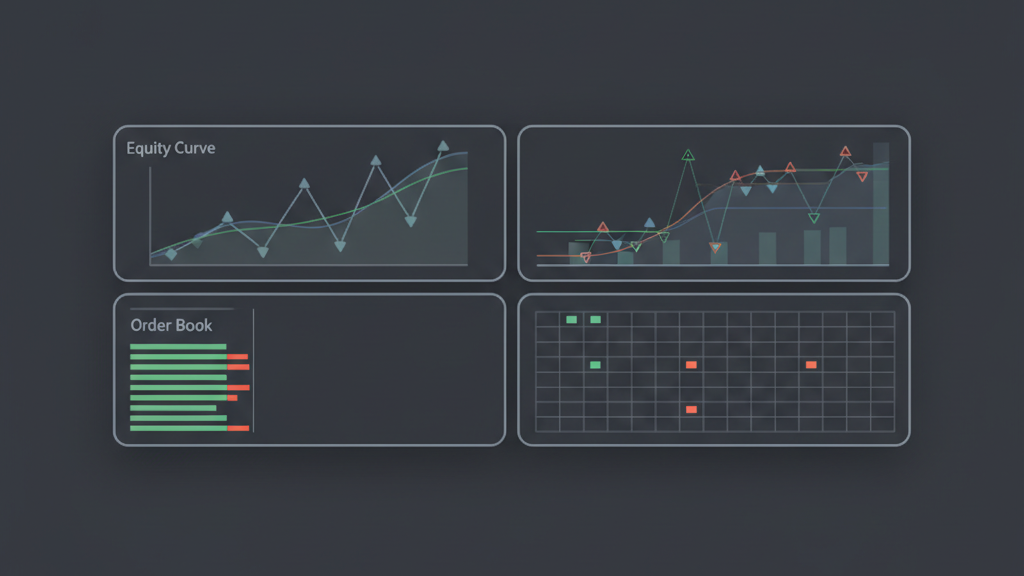
In the realm of algorithmic trading, the bedrock of any successful system lies in its ability to make consistent, data-driven decisions. This consistency is fundamentally achieved through rule-based strategies, where every action is dictated by predefined conditions rather than human intuition or emotion. However, merely having rules isn’t enough; the true challenge, and opportunity, lies in designing rule based strategies with robust entry exit criteria. These criteria are the explicit triggers that dictate when a position is initiated and, more critically, when it is closed to either capture profit or mitigate loss. A well-defined set of rules not only automates the decision-making process but also provides a quantifiable framework for backtesting, optimization, and risk management. This article dives into the practical aspects of developing these critical components, drawing from real-world experience in building and deploying high-performance trading systems.
The Core Philosophy of Rule-Based Strategy Design
At its heart, a rule-based strategy transforms subjective market analysis into an objective, executable algorithm. This shift is crucial for systematic trading, enabling consistent application of logic across diverse market conditions. When designing rule based strategies with robust entry exit criteria, the primary goal is to remove ambiguity and provide deterministic instructions to the execution engine. This means every condition, every threshold, and every action must be precisely defined, leaving no room for interpretation. The foundation of this approach is often built upon technical indicators, price action patterns, or even fundamental data points, but the real power comes from how these elements are combined to form a clear ‘if-then’ structure. Without this clarity, a strategy can devolve into arbitrary decisions, making it impossible to backtest accurately or manage risk effectively in a live environment. Our experience shows that strategies with fuzzy logic are prone to performance degradation and difficult to diagnose when issues arise.
Crafting Precision: Designing Robust Entry Criteria
Robust entry criteria are more than just a single indicator crossing a threshold; they represent a confluence of validating factors that signal a high-probability trade setup. A common mistake is relying on isolated signals, which often lead to premature entries and increased slippage when trying to fill orders. Effective entry logic typically involves multi-factor validation, incorporating elements like trend confirmation from moving averages, momentum signals from oscillators (e.g., RSI, Stochastic), volatility filters (e.g., ATR), and sometimes volume analysis to ensure genuine market participation. For instance, an entry might require a price breakout above resistance, confirmed by increasing volume, while RSI is not overbought, and the asset is trending above its 200-period moving average. Consideration must also be given to market microstructure: attempting to enter a large position during thin liquidity, even with a ‘perfect’ signal, will inevitably lead to poor fills. These considerations are baked directly into the entry conditions, for example, by only allowing entries if the spread is below a certain threshold or if a minimum daily volume has been met.
- Multi-indicator confluence to filter false signals and confirm trade setups.
- Volume and volatility filters to ensure sufficient liquidity and market interest.
- Time-based or session-based entry constraints to avoid illiquid periods.
- Order book depth and spread analysis to minimize entry slippage.
- Pre-trade checks for existing positions and overall portfolio exposure.
The Art of Exit: Building Effective Exit Criteria
While entry criteria capture attention, it’s the exit criteria that truly define a strategy’s profitability and risk profile. An effective exit strategy isn’t solely about taking profit; it’s about disciplined risk management and capital preservation. Exits can be static (e.g., fixed stop-loss, target profit) or dynamic (e.g., trailing stops, time-based exits, volatility-adjusted stops, or pattern invalidation). For instance, a strategy might use a percentage-based stop-loss immediately upon entry, a trailing stop to protect profits as the trade moves favorably, and a time-based exit if the trade hasn’t reached its target within a specified duration. The challenge lies in optimizing these exit parameters without overfitting historical data. We often find that a well-defined stop-loss, placed strategically based on market structure or volatility, is far more crucial than an aggressive profit target, as it caps potential losses and protects capital for future opportunities. Many traders make the error of having elaborate entry rules but simplistic exit rules, which often leads to giving back profits or taking excessive losses.
Rigorous Backtesting and Parameter Optimization
Once entry and exit criteria are formulated, the next critical step is rigorous backtesting. This is where the theoretical robustness of designing rule based strategies with robust entry exit criteria is put to the test against historical market data. It’s not just about running a strategy on a few years of data; it involves meticulous data cleansing, ensuring high-fidelity tick data, and accounting for real-world factors like latency, slippage, and commissions. A common pitfall is overfitting, where parameters are tuned so perfectly to historical data that they perform poorly in live trading. To mitigate this, we employ techniques like walk-forward optimization, where parameters are optimized on one segment of data and then tested on a subsequent, unseen segment. Monte Carlo simulations are also invaluable for assessing parameter sensitivity and understanding the range of possible outcomes. Algovantis’s backtesting engines are designed to simulate these real-world constraints accurately, allowing quants to iterate on their criteria with confidence, testing hundreds of parameter combinations to find robust, stable sets rather than just the historically ‘best’ ones.
- High-fidelity historical data: tick-level data, order book depth, corporate actions.
- Walk-forward optimization to combat overfitting and validate out-of-sample performance.
- Monte Carlo simulations for sensitivity analysis of key entry/exit parameters.
- Accurate modeling of real-world costs: commissions, slippage, and market impact.
- Robustness testing across different market regimes (trending, ranging, high/low volatility).
Bridging the Gap: Execution Challenges in Live Trading
The transition from backtested performance to live execution often reveals a chasm. Even the most robust entry exit criteria can be undermined by execution realities. Latency in data feeds and order routing can mean that a signal acted upon in the backtest is stale by the time an order hits the exchange. Slippage, especially for larger orders, can significantly erode expected profits. Partial fills are another common occurrence, where only a portion of an intended order is filled, leading to suboptimal position sizing or even missed opportunities. These factors necessitate building resilience directly into the strategy’s execution logic. For instance, using limit orders with time-in-force parameters, implementing smart order routing to find best execution venues, or dynamically adjusting position sizes based on current market liquidity are practical measures. Ignoring these real-world constraints, which are often abstracted away in simplistic backtests, is a fundamental mistake that can derail an otherwise sound strategy. Acknowledging and designing for these realities is a hallmark of truly robust systems.
Integrating Risk Management with Entry and Exit Logic
Risk management is not a separate module bolted onto a strategy; it’s an intrinsic part of designing rule based strategies with robust entry exit criteria. Every entry implies a maximum potential loss, and every exit dictates the realized profit or loss. Before any entry is considered, the strategy’s risk management framework must validate the trade. This includes position sizing algorithms (e.g., fixed fractional, Kelly criterion variations) that determine how much capital to allocate based on volatility and account size. Furthermore, portfolio-level risk controls, such as maximum drawdown limits, circuit breakers for individual symbols, or overall exposure caps, must interact seamlessly with the strategy’s entry rules. For example, a valid entry signal might be suppressed if it violates a portfolio-wide risk threshold or if the account is already approaching its maximum allowed drawdown. Similarly, exit rules might be triggered not just by price action but by an external risk event, like a sudden spike in volatility across the market, prompting an emergency exit to protect capital. This holistic approach ensures that risk is managed dynamically and proactively.
Continuous Monitoring and Adaptive Strategy Evolution
Market conditions are not static, and neither should be a trading strategy. Even with robust entry exit criteria, continuous monitoring is essential to detect performance degradation, concept drift, or changes in market microstructure that might render existing rules less effective. Real-time dashboards displaying key performance indicators (KPIs) like win rate, profit factor, average trade duration, and maximum drawdown provide immediate feedback. Beyond simple performance metrics, implementing anomaly detection for trade frequencies, order sizes, or fill rates can flag potential issues with data feeds or exchange connectivity. When a strategy begins to underperform or deviates from its expected behavior, it’s crucial to have a disciplined process for re-evaluation and adaptation. This might involve recalibrating parameters, refining existing rules, or even developing entirely new criteria based on evolving market dynamics. Algovantis platforms facilitate this iterative process, allowing for controlled A/B testing of new rule sets in paper trading environments or small-scale live deployments before full-scale deployment.
- Real-time monitoring of strategy performance KPIs and execution metrics.
- Detection of concept drift and market regime changes affecting rule efficacy.
- Controlled A/B testing of updated entry/exit criteria in simulated or small live environments.
- Automated alerts for unusual trading behavior, data feed issues, or API failures.
- Version control for strategy rules to track changes and facilitate rollback if needed.