Deploying an automated trading system isn’t just about pushing code; it’s a high-stakes operation where milliseconds and market state dictate success or failure. The journey from development to live execution is fraught with potential pitfalls, from subtle logic errors to catastrophic connectivity issues. Ensuring a stable, predictable transition is paramount, especially when real capital is on the line. Furthermore, despite rigorous testing, unforeseen circumstances can arise post-deployment, necessitating immediate and effective mitigation. This is where robust execution rollback strategies become indispensable, providing a safety net to prevent runaway losses and restore system integrity when things inevitably go sideways. Understanding these processes isn’t optional; it’s fundamental to operating a resilient and profitable algorithmic trading infrastructure.
The Criticality of Robust Deployment in Algo Trading
Deploying an automated trading system demands more than just copying executables; it requires a meticulously planned, atomic operation to minimize exposure to market volatility and potential data inconsistencies. In production, even minor environmental discrepancies, such as library versions or network configurations, can introduce subtle bugs that bypass pre-production testing. A robust deployment pipeline must account for dependency management, ensuring all required components are correctly installed and configured without manual intervention. The goal is to achieve a state where a new deployment either fully succeeds and takes over or completely fails and reverts, without leaving the system in an indeterminate, partially updated state. This approach significantly reduces the risk of operational errors and provides a clear path for troubleshooting, which is vital when every second counts in a live trading environment. Ignoring these details often leads to unpredictable behavior and significant P&L impact.
Staging Environments and Pre-Deployment Validation
Before any `automated trading system deployment` hits production, it must pass rigorous validation in a staging environment that mirrors the live setup as closely as possible. This isn’t just about functional testing; it involves simulating real market conditions, order flows, and latency profiles. A well-designed staging environment uses production-like data, either real-time feeds or meticulously replayed historical data, to identify potential issues with data parsing, order placement logic, and connectivity to brokers or exchanges. Critical validation steps include performance benchmarking under expected and peak loads, stress testing API rate limits, and ensuring all risk controls and circuit breakers function as intended. The objective is to catch as many edge cases and infrastructure-related issues as possible, well before they can impact live trading. Overlooking these pre-checks is a common misstep, often leading to costly execution failures in production.
- Verify data feed connectivity and parsing latency in a simulated environment.
- Execute a battery of integration tests against a mock broker API for order routing and position updates.
- Benchmark strategy execution speed and resource consumption under various market conditions.
- Test all custom risk parameters and kill switch functionalities to ensure correct triggering and state transitions.
- Validate post-trade reconciliation processes and data persistence layers.
Strategies for Zero-Downtime Deployment
Achieving near-zero downtime during an automated trading system deployment is critical to avoid missing market opportunities or leaving open positions unmanaged. Techniques like blue/green deployments or canary releases are instrumental here. In a blue/green setup, a new version (green) is deployed alongside the current production version (blue). Once the green environment is validated, traffic is gradually or instantly switched from blue to green. The old blue environment remains active as a rollback target. Canary deployments take this a step further, routing a small percentage of live traffic to the new version, slowly increasing the load while closely monitoring performance and P&L. If any anomalies are detected, traffic is immediately routed back to the stable version. These strategies minimize exposure to new code risks and provide immediate rollback capability without affecting the majority of the trading operations. The challenge lies in managing stateful components and ensuring smooth transitions for actively trading strategies.
Implementing Effective Execution Rollback Strategies
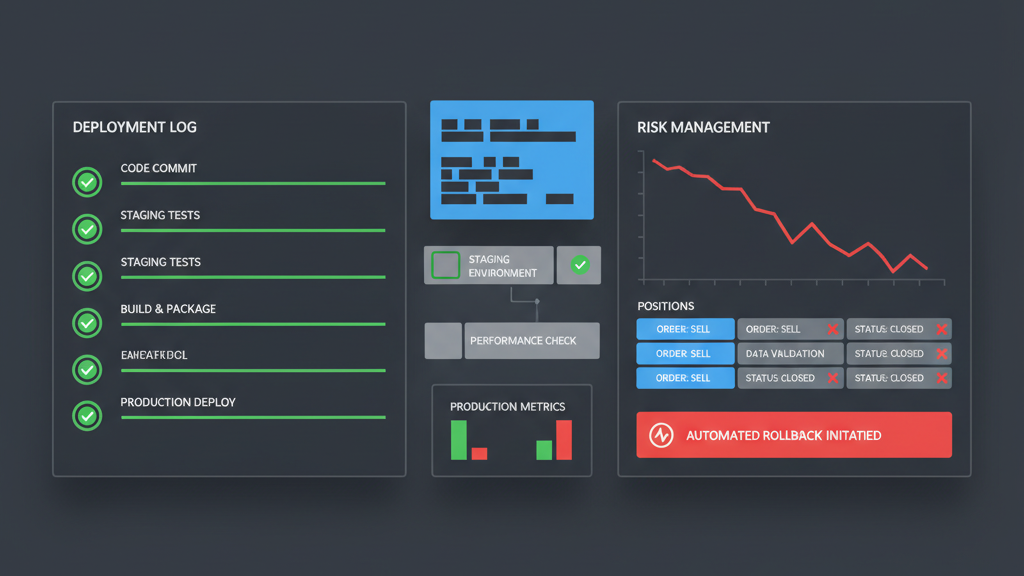
Effective execution rollback strategies are the ultimate safety net for any automated trading system. A rollback isn’t just about reverting code; it’s about systematically unwinding market exposure, restoring data integrity, and returning the system to a known stable state. This involves more than simply redeploying an older version. It requires a clear, predefined sequence of actions, often including canceling all open orders, flattening existing positions, and potentially reverting database states to a pre-deployment snapshot. The complexity escalates with strategies that maintain persistent state or open positions across multiple assets or exchanges. Key considerations include the latency of broker API calls for cancellations, potential slippage during rapid position closing, and ensuring that the rollback process itself doesn’t introduce new risks. A well-defined rollback plan acts as a ‘break glass in case of emergency’ protocol, minimizing potential financial damage during critical system failures.
- Define specific triggers for an automated rollback (e.g., P&L threshold breaches, excessive message latency, critical error logs).
- Develop an ‘all-pairs’ cancellation and position flattening module for all active instruments and brokers.
- Implement transaction-aware database snapshots or versioning to restore system state.
- Design a clear communication protocol for operators during an emergency rollback.
- Regularly test rollback procedures in staging environments under simulated stress conditions.
Post-Deployment Monitoring and Anomaly Detection
Once an automated trading system deployment is live, continuous and vigilant monitoring is non-negotiable. This involves real-time tracking of critical metrics such as order fill rates, execution latency, P&L attribution, resource utilization, and API response times. Advanced anomaly detection systems, often employing machine learning, can flag deviations from baseline behavior that might indicate subtle issues not caught during testing. For instance, a sudden spike in rejected orders, an unexplained drop in market data throughput, or a deviation from expected strategy P&L can all serve as early warning signs. Comprehensive logging, structured for easy analysis, is vital for post-mortem investigations. The goal is to rapidly identify any adverse performance or behavioral shifts that could necessitate an immediate execution rollback, making the monitoring suite the first line of defense against live trading errors.
The ‘Circuit Breaker’ and Emergency Kill Switches
Beyond general execution rollback strategies, every robust automated trading system needs an explicit ‘circuit breaker’ and a range of emergency kill switches. These are hard-coded mechanisms designed to halt trading activity instantly, preventing catastrophic losses in scenarios where automated rollback might be insufficient or too slow. A circuit breaker automatically triggers based on predefined criteria, such as exceeding daily P&L limits, hitting maximum drawdown thresholds, or detecting severe market data feed disruptions. Manual kill switches, accessible via a secure, low-latency interface, provide human operators with the ability to stop all trading, cancel all orders, or even shut down the entire system at a moment’s notice. Implementing these safety nets requires careful architectural planning to ensure they operate independently of the main trading logic, making them resilient to core system failures. Their proper functioning is paramount, often requiring dedicated testing to ensure they activate as expected under pressure, providing a final layer of protection.