The Relative Strength Index (RSI) is a ubiquitous momentum oscillator, a staple in many algorithmic trading strategies. Its core parameter, the lookback period, dictates its sensitivity and signal generation frequency. However, simply backtesting a strategy with a fixed, historically optimal lookback often leads to significant overfitting, producing stellar theoretical results that fail miserably in live trading. To overcome this, we employ robust optimization techniques. This article delves into how we approach RSI indicator lookback optimization using walk-forward validation, a critical methodology for building adaptive and resilient trading systems that perform reliably across varied market regimes and prevent curve-fitting to historical data.
The Challenge of RSI Lookback Selection and Overfitting
Selecting the ‘right’ lookback period for the RSI indicator is rarely straightforward. A shorter lookback, like 7 periods, makes the RSI more volatile and responsive to price changes, potentially generating more signals but also increasing whipsaws. A longer lookback, such as 21 periods, smooths the RSI, reducing false signals but potentially delaying entry and exit points. The temptation for many developers is to backtest a strategy across a wide range of lookback values, identify the one that yielded the highest historical profit or Sharpe ratio, and then hardcode it. This approach, while seemingly logical, is a classic recipe for overfitting. The ‘optimal’ lookback found through this method is merely the one that best explains past price action, not necessarily one that will continue to perform well in new, unseen market data. This often leads to a significant performance degradation when the strategy transitions from backtesting to live execution, primarily because the market dynamics that favored a particular lookback during the historical period may not persist.
Why Simple Backtesting Fails: The Overfitting Trap
Traditional backtesting, where a single set of parameters is optimized over the entire historical dataset, implicitly assumes that market behavior is stationary. This is a dangerous assumption in financial markets, which are inherently non-stationary and constantly evolving. When you optimize an RSI lookback (or any indicator parameter) over a long, fixed period, you are essentially fitting your strategy to noise and specific historical events. The resulting ‘optimized’ parameter set becomes highly fragile, performing exceptionally well on the data it was trained on but collapsing when exposed to new data, which is precisely what happens in live trading. This overfitting phenomenon is a primary reason why many theoretically profitable backtested strategies fail in practice. It’s not just about finding *a* good lookback, but finding one that is *robust* and adaptive enough to handle future market conditions, which demands a more sophisticated validation approach than simple in-sample optimization.
Understanding Walk-Forward Validation for Robust Optimization
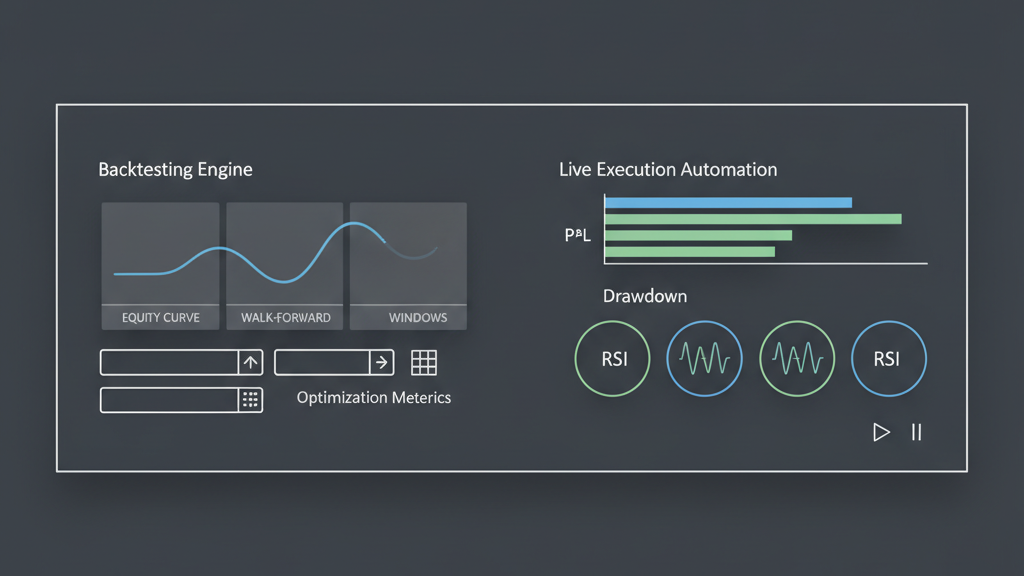
Walk-forward validation is a rigorous methodology designed to combat overfitting by simulating how an algorithmic strategy would perform if its parameters were periodically re-optimized over time. Instead of optimizing on the entire dataset once, the data is split into sequential ‘training’ (in-sample) and ‘testing’ (out-of-sample) windows. A specific RSI lookback is optimized within the first training window, and then its performance is evaluated strictly on the subsequent, unseen testing window. After this, the windows ‘walk forward’ in time: the training window slides to include the previous testing data, and a new, future testing window is designated. The re-optimization process repeats, generating a series of optimal lookbacks and their corresponding out-of-sample performances. This simulates a real-world scenario where a trader would periodically re-evaluate and adjust their strategy’s parameters, providing a much more realistic assessment of its long-term viability and adaptiveness.
- **Training Window (In-Sample):** Used to optimize the RSI lookback, typically covering a significant historical period.
- **Testing Window (Out-of-Sample):** A subsequent, unseen period where the optimized lookback from the training window is applied and evaluated.
- **Re-optimization Interval:** The frequency at which the strategy’s parameters are re-optimized (e.g., every 3 months, 6 months).
- **Walk-Forward Period:** The entire duration over which this sequential optimization and testing process is carried out.
Implementing Walk-Forward for RSI Indicator Lookback Optimization
Implementing RSI indicator lookback optimization using walk-forward validation in a trading system requires careful data management and a structured approach. First, define the range of RSI lookback values to test (e.g., 5 to 30). Then, establish the length of your training and testing windows, and the re-optimization interval. For instance, you might use a 1-year training window, a 3-month testing window, and re-optimize every 3 months. Our backtesting engines automate this: for each walk-forward segment, the system iterates through the specified lookback range on the training data, optimizing for a predefined objective function (e.g., maximizing net profit, Sharpe Ratio, or Calmar Ratio). The best-performing lookback from that training window is then locked in and applied to the subsequent testing window. This process is repeated until the entire historical dataset has been covered, yielding a series of out-of-sample performance metrics and a history of optimal lookback values.
- **Data Splitting Logic:** Ensure proper, non-overlapping training and testing windows for each walk-forward step.
- **Optimization Objective:** Define clear metrics (Sharpe, profit factor, maximum drawdown) to guide the ‘best’ lookback selection.
- **Computational Cost:** Be aware that walk-forward optimization is significantly more computationally intensive than static optimization.
- **Lookback Range:** Start with a reasonable range (e.g., 5-30, 10-50 periods) and refine based on initial results.
Evaluating Performance and Robustness
The true value of RSI lookback optimization using walk-forward validation isn’t just about finding the highest overall profit, but assessing the consistency and robustness of the strategy’s performance across different market regimes represented by the out-of-sample testing windows. Key metrics to analyze include the Sharpe ratio, Max Drawdown, Profit Factor, and average trade expectancy across *all* the testing segments. If the strategy’s performance metrics are consistently positive and stable across these segments, it indicates a robust and adaptive system. Conversely, wildly fluctuating performance, or segments with significant losses, signals fragility. It’s also critical to examine the distribution of the ‘optimal’ RSI lookback values identified in each training window. If these values are highly unstable or jump around erratically, it suggests that the strategy’s profitability might be too sensitive to minor parameter changes, indicating a lack of robustness that needs further investigation or a different optimization approach.
Real-World Challenges and Execution Gaps
Even with thorough walk-forward validation, deploying an RSI-optimized strategy into live trading presents its own set of challenges. Latency is a critical factor; even a few milliseconds can impact execution quality, leading to slippage that degrades the theoretical edge. Data quality issues, such as missing ticks or incorrect historical prices, can skew optimization results, making a seemingly robust lookback perform poorly in production. Furthermore, API failures, exchange connectivity problems, and unexpected market events (e.g., flash crashes) can create execution gaps not accounted for in backtesting. The re-optimization process itself, while crucial for adaptiveness, introduces complexity. When a new optimal lookback is identified, the system must gracefully transition to using it without interrupting active trades or introducing unintended side effects. Continuous monitoring of live performance against out-of-sample benchmarks is essential, alongside robust error handling and fail-safes within the execution automation framework to mitigate these real-world risks.
Integrating Dynamic RSI Lookbacks into Live Execution
Once the RSI indicator lookback optimization using walk-forward validation has yielded a robust strategy, integrating these dynamic parameters into a live execution system is the next critical step. Algovantis’s execution automation tools are designed to handle this. The system needs to be configured to periodically perform the walk-forward re-optimization (e.g., monthly or quarterly) and automatically update the active strategy’s RSI lookback parameter. This requires a modular architecture where the optimization module can run independently and feed updated parameters to the live trading engine. Furthermore, a robust monitoring framework is essential to track the strategy’s performance post-re-optimization, comparing it against the expected out-of-sample results from the walk-forward validation. Drift detection, where the live performance significantly deviates from backtested expectations, should trigger alerts and potentially a review of the re-optimization process or the underlying market conditions. This continuous feedback loop ensures that the strategy remains adaptive and resilient over its operational lifespan.