Developing robust algorithmic trading strategies hinges on thorough backtesting. However, a common pitfall is overfitting, where a strategy performs exceptionally well on historical data but fails spectacularly in live markets. This often stems from parameters being ‘curve-fitted’ to specific historical market nuances. While simple out-of-sample testing offers a basic check, it doesn’t fully address the dynamic nature of market conditions and the stability of strategy parameters over time. This is where walk forward optimization (WFO) emerges as a more sophisticated and realistic approach, mimicking how a strategy would be adaptively managed in a live trading environment. Understanding the distinction and application of WFO is crucial for any serious algo developer looking to build truly resilient systems.
The Pervasive Threat of Overfitting in Backtesting
Overfitting is a silent killer in algorithmic trading strategy development. It occurs when a strategy’s parameters are tuned too precisely to the historical data used for backtesting, capturing noise and transient market features rather than genuine, persistent edges. This can happen through excessive parameter optimization, data snooping bias, or simply iterating on a strategy until its equity curve looks perfect on historical data. The insidious nature of overfitting is that it gives a false sense of security, showing impressive profit factors and low drawdowns in a simulated environment, only for the strategy to underperform or even implode once deployed with real capital. Recognizing and actively mitigating overfitting is fundamental to transitioning any strategy from the research phase to live deployment with confidence, necessitating rigorous validation techniques that go beyond simple data splits.
Limitations of Static Out-of-Sample Testing
Many developers start by splitting their historical data into an in-sample (IS) period for optimization and an out-of-sample (OOS) period for validation. While a necessary first step, this static approach has significant limitations in real-world algo trading. The primary issue is that even if a strategy performs well on the OOS data, the optimized parameters were chosen once based on a fixed historical context. Markets are non-stationary; parameters that were optimal for the 2008 crash might be suboptimal for a low-volatility regime or a high-inflation environment. A single OOS test, while better than none, offers only a snapshot and doesn’t confirm the strategy’s adaptive capability or the robustness of its parameters when faced with evolving market dynamics. It’s a pass/fail test for a specific, past market slice, not a continuous performance indicator.
- Optimized parameters are fixed, not adaptive.
- Fails to account for market non-stationarity over time.
- Provides only a single, static validation point.
- Can still lead to ‘lucky’ OOS performance that isn’t robust.
Understanding Walk Forward Optimization (WFO)
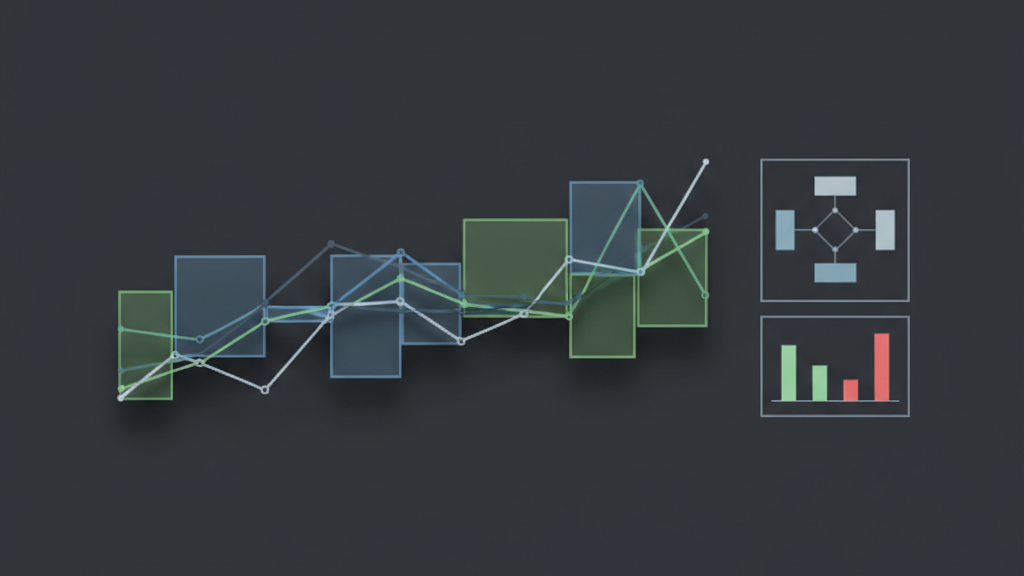
Walk forward optimization addresses the limitations of static testing by simulating the iterative process of optimizing and deploying a strategy in a real-world scenario. Instead of a single optimization, WFO divides the historical data into multiple sequential optimization windows and corresponding test windows. The strategy’s parameters are optimized on the first in-sample window, then immediately tested on the subsequent out-of-sample window. This process then ‘walks forward’: the optimization window slides, new parameters are found, and the strategy is tested on the next out-of-sample segment. The combined performance of all these individual out-of-sample test periods provides a more realistic and robust assessment of the strategy’s viability, demonstrating its ability to maintain profitability as market conditions and optimal parameters evolve over time, much like a live trading system would be periodically recalibrated.
Implementing and Interpreting Walk Forward Results
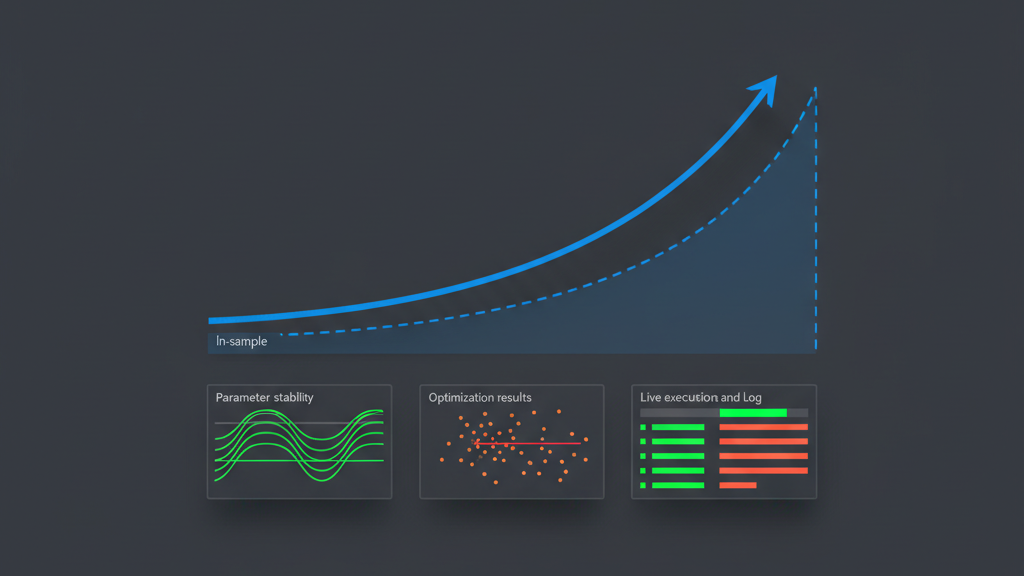
Implementing WFO requires careful consideration of window sizes: the length of the optimization window, the length of the walk-forward test window, and the step size by which these windows advance. Typical setups might use a 2-year optimization window, a 6-month test window, advancing every 3 months. The computational overhead is significantly higher than a single backtest, as numerous optimizations are performed. Interpreting the results involves more than just the final equity curve from the concatenated test periods. Developers must also analyze parameter stability—how much optimal parameters shift between windows—and the consistency of performance metrics like Sharpe ratio, max drawdown, and profit factor across each walk-forward segment. A robust strategy will show relatively stable parameters and consistent performance, even if not spectacular, across all out-of-sample periods, indicating adaptability and resilience.
- Define optimization window length and step size.
- Analyze parameter stability across optimization windows.
- Evaluate performance metrics for each test segment.
- Look for consistent performance, not just peak returns.
- A robust WFO result implies the strategy can adapt to changing market conditions.
Practical Challenges and Real-World Constraints
While WFO is a powerful tool, it’s not a silver bullet. Practical implementation faces several challenges. Data quality is paramount; any survivorship bias, look-ahead bias, or missing data within rolling windows can skew results. Computational resources can become a bottleneck, especially with high-frequency data and large parameter spaces, often necessitating distributed computing solutions. Furthermore, WFO still operates within a historical context. It cannot account for unforeseen ‘black swan’ events or entirely new market paradigms. The ‘optimization of the optimization’ problem also arises, where developers might over-optimize the WFO settings themselves (window lengths, step sizes), introducing another layer of potential overfitting. The results provide an indication of historical robustness, but real-time execution challenges such as latency, slippage, and API failures remain critical factors that WFO, by itself, does not directly simulate.
Beyond WFO: Enhancing Robustness with Additional Techniques
To truly combat overfitting and build resilient algorithmic strategies, WFO should be combined with other robustness checks. Sensitivity analysis, for example, involves perturbing optimal parameters slightly to see if performance degrades significantly, indicating a fragile solution. Monte Carlo simulations can test a strategy’s performance under various market paths and parameter variations, providing statistical confidence intervals. Stress testing involves specifically evaluating performance during historical market crises or extreme volatility events. Furthermore, considering an ensemble approach, where multiple strategies or multiple parameter sets are traded simultaneously, can diversify risk and improve overall system stability. Ultimately, a robust strategy is one that performs adequately across a wide range of plausible conditions, not just optimally in one specific historical sequence, and this requires a multi-faceted approach to backtesting and validation that moves beyond any single methodology.